Saudi Arabia, Türkiye and Pakistan Sign Makkah Joint Defense Agreement

-
Saudi Arabia, Türkiye and Pakistan Deepen Defense Cooperation Amid Regional Geopolitical Tensions
-
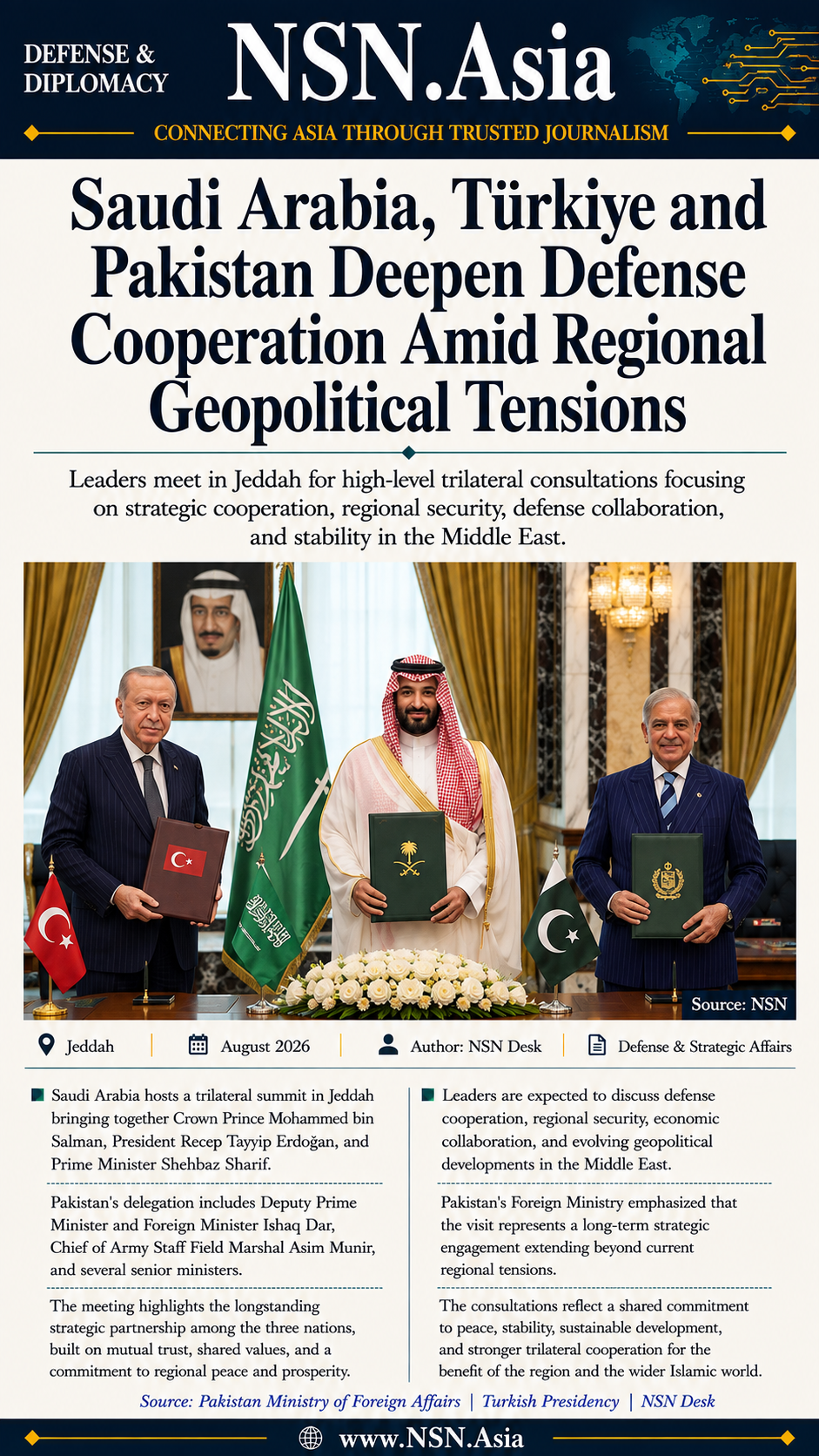
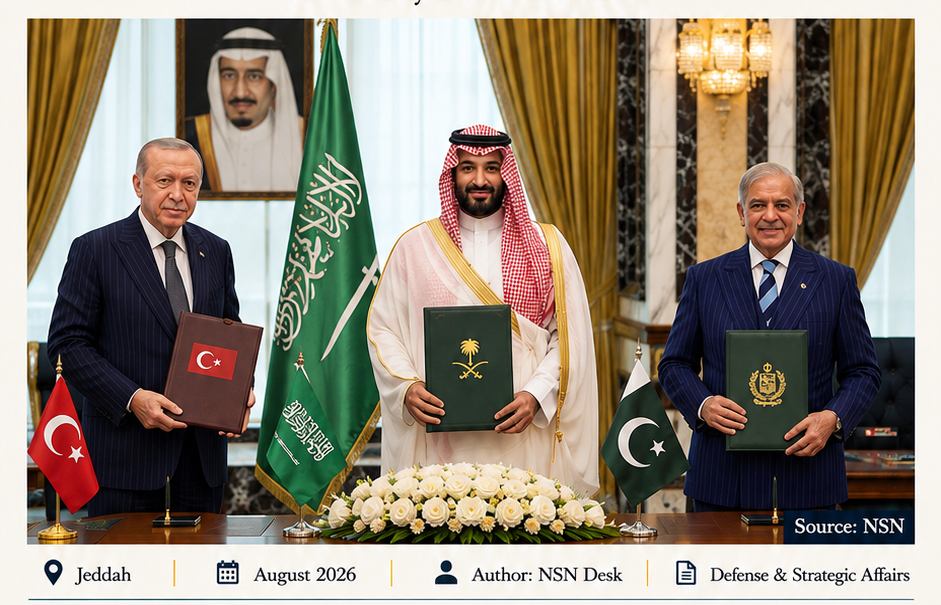
Defense agreement was signed by Crown Prince and Prime Minister Mohammed bin Salman, Turkish President Recep Tayyip Erdoğan and Pakistani Prime Minister Muhammad Shehbaz Sharif during the Makkah Joint Defense Summit at Al-Safa Palace.
By: Muhammad Arif, Editor NSN.Asia
Makkah, Saudi Arabia — Saudi Arabia, Türkiye and Pakistan signed the Makkah Joint Defense Agreement on Friday, establishing a collective defense framework under which any armed attack against one of the three countries will be considered an attack against all.
The agreement was signed by Crown Prince and Prime Minister Mohammed bin Salman, Turkish President Recep Tayyip Erdoğan and Pakistani Prime Minister Muhammad Shehbaz Sharif during the Makkah Joint Defense Summit at Al-Safa Palace.
Erdoğan and Sharif visited Saudi Arabia at the invitation of Custodian of the Two Holy Mosques King Salman bin Abdulaziz and were received by the Crown Prince at the Royal Court in Makkah.
Background
Ties between Saudi Arabia, Türkiye and Pakistan have deepened steadily over the past year against a turbulent regional backdrop. Since February, the Middle East has been gripped by a broader conflict involving Iran, with Gulf states — including Saudi Arabia — coming under direct fire, alongside renewed instability from Iran-aligned militias in Yemen and Iraq. These pressures pushed Riyadh, Ankara and Islamabad to move from informal coordination toward a formal, codified security relationship.
The trilateral pact did not emerge in isolation. It builds directly on the Strategic Mutual Defence Agreement signed by Saudi Arabia and Pakistan in September, which was itself described as a watershed moment in bilateral relations, elevating the two countries’ partnership from friendship to a formal defense commitment. That earlier accord focused primarily on bilateral security guarantees and the stationing of Pakistani forces in the Kingdom. Türkiye’s inclusion this time reflects a broader ambition: combining Saudi financial resources, Turkish defense-industrial and technological capacity, and Pakistan’s battle-tested military and nuclear deterrence into a single, integrated framework.
A New Collective Security Framework
During the summit, the three leaders reviewed the longstanding relations between Saudi Arabia, Türkiye and Pakistan and discussed a range of issues of mutual interest.
A joint statement said the agreement builds on the three countries’ historical ties, Islamic solidarity, shared strategic interests and close defense cooperation.
The agreement aims to strengthen joint deterrence against any aggression and stipulates that any armed attack against one of the three countries will be regarded as an attack against all three. It also seeks to develop and expand all aspects of defense cooperation among Saudi Arabia, Türkiye and Pakistan.
The three countries said the pact reflects their commitment to strengthening shared security and contributing to peace and stability in the region and globally, while working toward a secure and prosperous future.
Signed Against a Backdrop of Regional Turmoil
The signing comes at a moment of heightened tension across the Middle East. Saudi Arabia has faced repeated strikes linked to the wider conflict involving Iran, and the region has seen renewed instability in Yemen, adding urgency to the push by Riyadh, Ankara and Islamabad to formalize their security cooperation.
The trilateral pact brings together three distinct sources of strength: Türkiye’s position as a major military power within NATO, Saudi Arabia’s economic and diplomatic weight as home to Islam’s holiest sites, and Pakistan’s status as the only nuclear-armed Muslim-majority nation. Officials familiar with the agreement have described it as combining Saudi financing, Turkish defense technology and Pakistani military capability into a single framework.
The Makkah Joint Defense Agreement follows and expands upon the Strategic Mutual Defence Agreement signed by Saudi Arabia and Pakistan in September, which similarly declared that an attack on either country would be treated as an attack on both. Officials note that the new trilateral pact differs in scope, moving beyond earlier arrangements to encompass joint defense-industrial development and broader security coordination among all three nations, rather than being limited to bilateral military arrangements.
Officials involved in the talks have stressed that the agreement is defensive in nature and is not directed at any specific country. They have also indicated that it does not replace or override any existing bilateral or multilateral agreements the three nations hold with other states or organizations, and that the framework remains open to other regional countries that may wish to join in the future.
Strengthening Ties Between Sunni Muslim Powers
The agreement further cements a growing alignment among major Sunni Muslim-majority states allied with the United States, reinforcing a security relationship that has deepened steadily over the past year. Analysts see the pact as a significant milestone in South Asia–Middle East relations, formally elevating the trilateral relationship from strategic partnership to a mutual defense commitment.
For Pakistan, the agreement reinforces its role as a security partner to Gulf states at a time of regional uncertainty. For Saudi Arabia, it provides an added layer of deterrence amid ongoing threats in its neighborhood. For Türkiye, it extends its defense-industrial and strategic reach further into the Gulf and South Asia.
The three governments have framed the agreement as a forward-looking commitment — one intended not only to safeguard their own security but to contribute to broader peace and stability across the region and beyond.

Presidency of the Republic of Türkiye Recep Tayyip Erdoğan, who is in Makkah for a working visit, met with Crown Prince and Prime Minister Mohammed bin Salman of Saudi Arabia.
Conclusion
The Makkah Joint Defense Agreement marks one of the most consequential shifts in Middle East–South Asia security relations in recent memory. By formally binding the military fates of a leading NATO power, the Arab world’s most influential Gulf state, and the Muslim world’s only nuclear-armed nation, Saudi Arabia, Türkiye and Pakistan have signaled that their security is now mutually indivisible. The pact does not merely restate existing bilateral commitments — it creates a genuinely trilateral deterrent structure at a moment when the regional balance of power is under active strain from the Iran conflict and its spillover effects.
Way Forward
Attention will now turn to how the agreement is implemented in practice. Key questions likely to shape its trajectory include:
- Institutional mechanisms: Whether the three countries establish standing joint command structures, intelligence-sharing protocols, or a permanent coordinating body to operationalize the pact beyond its political declaration.
- Defense-industrial integration: How Saudi capital, Turkish technology and manufacturing, and Pakistani military expertise are combined into joint production or procurement programs, building on the “weapons production” focus reported ahead of the signing.
- Regional reception: How neighboring and global powers — including the United States, Iran, and Israel — respond to the emergence of a formal Sunni-majority defense bloc, and whether the agreement affects ongoing diplomatic processes in the region.
- Openness to new members: Officials have indicated the pact is not directed at any specific actor and remains open to other regional states. Whether additional countries seek to join could determine whether this becomes a narrow trilateral arrangement or the nucleus of a broader regional security architecture.
- Coexistence with existing alliances: How the agreement is reconciled with Türkiye’s NATO obligations, Saudi Arabia’s ties with Washington, and Pakistan’s existing defense relationships, given assurances that it does not override prior bilateral or multilateral commitments.
For now, the agreement stands as a clear statement of intent: three historically aligned nations, drawn closer by shared faith, strategic necessity and a volatile regional environment, are betting that collective deterrence offers the surest path to security in an increasingly uncertain Middle East.