CooperationNewsNSNPakistan-China CooperationPhotosSilk Road

HEC Chairman Visits Chinese Embassy in Islamabad to Strengthen Pakistan-China Higher Education Cooperation

Chairman of the Higher Education Commission (HEC), Prof. Dr. Niaz Ahmad Akhtar, appreciates the Chinese Embassy's continued support for higher education collaboration

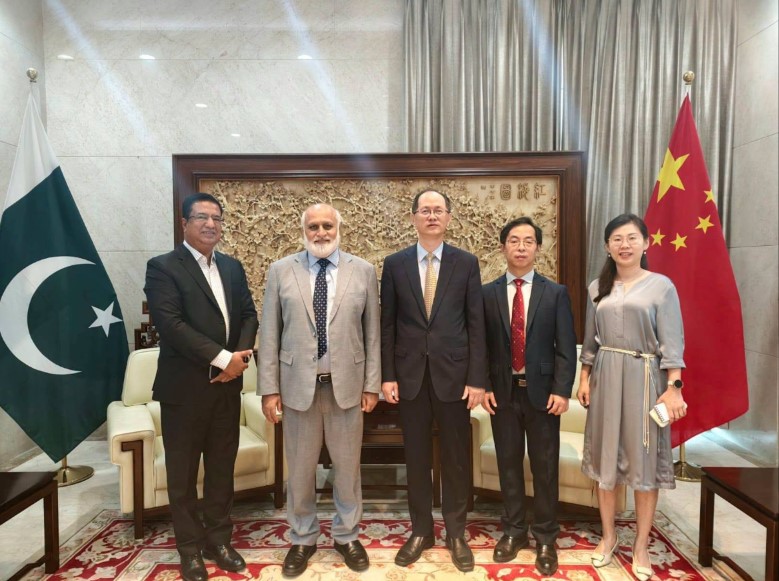
  • HEC Chairman Visits Chinese Embassy in Islamabad to Strengthen Pakistan-China Higher Education Cooperation

  • Chairman of the Higher Education Commission (HEC), Prof. Dr. Niaz Ahmad Akhtar, appreciates the Chinese Embassy’s continued support for higher education collaboration

  • As CPEC enters its second phase, education has emerged as a central pillar alongside infrastructure and energy

  • By: Muhammad Arif, Editor NSN.Asia
Islamabad — Chairman of the Higher Education Commission (HEC), Prof. Dr. Niaz Ahmad Akhtar, visited the Embassy of the People’s Republic of China in Islamabad and held a meeting with Mr. Shi Yuanqiang, Deputy Head of Mission, Mr. Chen Peng, Cultural Counsellor, and senior Embassy officials.
Chairman HEC Meets Deputy Head of Mission of Chinese Embassy in Islamabad, NSN Asia 2026
The meeting focused on further strengthening Pakistan–China cooperation in higher education through enhanced academic and research collaboration, institutional partnerships, faculty and student exchanges, innovation, and greater mobility of scholars.
During the meeting, Chairman HEC reaffirmed the Commission’s commitment to deepening strategic academic linkages between Pakistan and China and advancing joint initiatives that promote academic excellence, research, innovation, and human capital development.
He appreciated the Embassy’s continued support for higher education collaboration and expressed confidence that sustained academic engagement would further strengthen the longstanding friendship and all-weather strategic cooperative partnership between Pakistan and China.
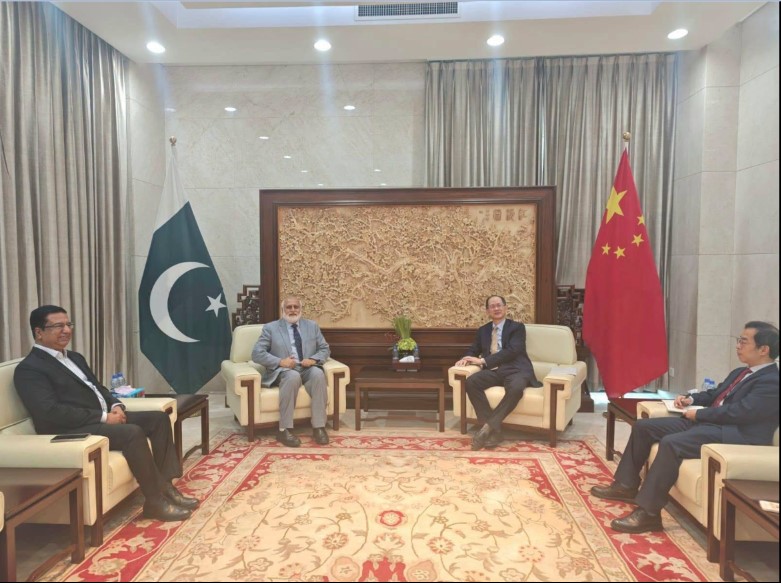
Chairman HEC Meets Deputy Head of Mission of Chinese Embassy in Islamabad, NSN Asia 2026
Background
Dr. Niaz Ahmad Akhtar, a chemical engineer by training and former Vice-Chancellor of Quaid-i-Azam University Islamabad, the University of the Punjab, and UET Taxila, assumed charge as HEC Chairman in February. Since taking office, he has made Pakistan-China academic engagement a defining priority of his tenure, undertaking a series of high-level visits to China and hosting reciprocal engagements with Chinese institutions in Islamabad.
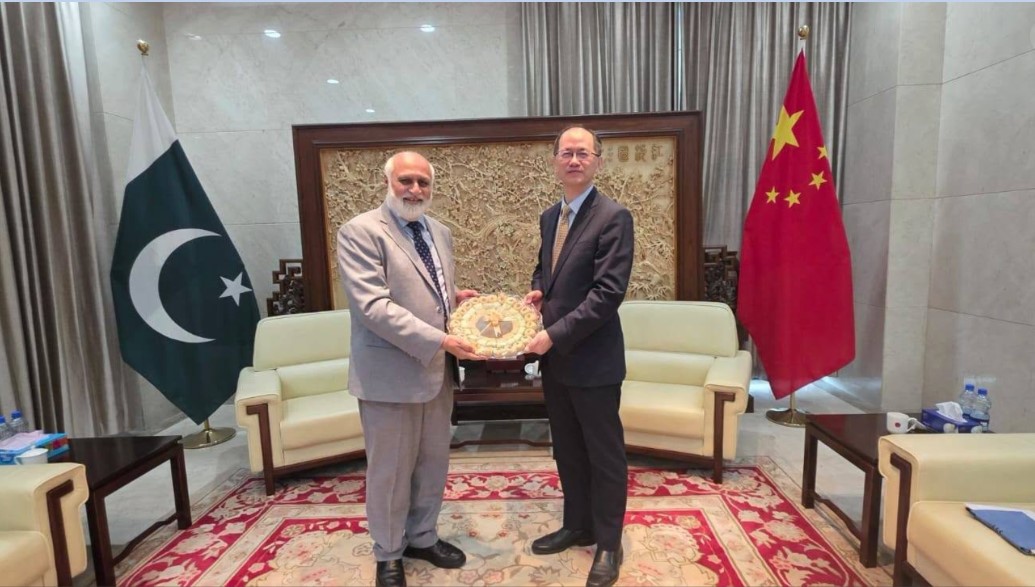
Chairman HEC Meets Deputy Head of Mission of Chinese Embassy in Islamabad, NSN Asia 2026
In July, Dr. Akhtar led a high-powered HEC delegation — comprising vice-chancellors and rectors from leading Pakistani universities including NUST, COMSATS, Bahria University, the University of Sindh, BUITEMS Quetta, UET Peshawar, Kotli University AJK, and the University of Sargodha — on a week-long visit to China. The delegation held talks at Beijing Language and Culture University, met with the leadership of Fudan University in Shanghai, and engaged with the China Association of Higher Education (CAHE), where Dr. Akhtar proposed a long-term “Pak-China Higher Education Framework 2035” built around five pillars: language and culture exchange, talent and human capital development, innovation and research cooperation, digital transformation of universities, and a Pak-China Knowledge Corridor.
That visit also produced concrete outcomes, including twin agreements signed in Beijing to bring Chinese vocational training expertise and AI-enabled classrooms to Pakistani campuses, along with a two-way teacher and student exchange programme, a mutual credit-recognition mechanism, and a new scholarship for outstanding Pakistani students. On his return, Dr. Akhtar chaired a meeting of the CPEC Consortium of Universities — a platform that has grown since 2017 to include 93 Pakistani and 40 Chinese universities — urging member institutions to convert the many memorandums of understanding signed over the years into measurable outcomes such as joint and dual degree programmes, co-publications, and collaborative research in fields including artificial intelligence, semiconductors, biotechnology, and cybersecurity.
Friday’s meeting at the Chinese Embassy in Islamabad builds directly on this momentum, bringing the follow-up on those Beijing engagements to the diplomatic table in Pakistan and reinforcing the institutional channel between HEC and Chinese authorities through the Embassy’s Deputy Head of Mission and Cultural Counsellor.
Conclusion
The Islamabad meeting underscores that Pakistan-China higher education cooperation has moved well beyond symbolic memoranda toward a structured, sustained partnership involving Pakistan’s leading universities, China’s premier academic institutions, and both countries’ diplomatic missions. With HEC leadership now engaging Chinese counterparts at multiple levels — from university-to-university agreements to embassy-level coordination — the relationship reflects a deliberate effort to translate the two countries’ “all-weather strategic cooperative partnership” into tangible academic and research outcomes.
The Way Forward: Educational Diplomacy Under CPEC
As the China-Pakistan Economic Corridor (CPEC) enters its second phase, education has emerged as a central pillar alongside infrastructure and energy. The growing network of academic MOUs, joint scholarships, faculty exchanges, and the CPEC Consortium of Universities point to a broader strategy: building the human capital and research ecosystem needed to sustain CPEC’s long-term economic goals, from technology transfer to skilled workforce development for Chinese-funded enterprises operating in Pakistan.
Educational diplomacy of this kind serves multiple purposes for both countries. For Pakistan, it offers access to Chinese expertise in areas such as artificial intelligence, semiconductors, digital transformation, and vocational training — fields critical to modernizing its higher education system and industrial base. For China, it deepens people-to-people ties and cultivates a generation of Pakistani graduates, researchers, and professionals familiar with Chinese language, technology, and institutions, reinforcing the durability of the bilateral relationship beyond government-to-government agreements.
Going forward, the extent to which this engagement translates into measurable results — joint and dual degree programmes, functioning research partnerships, expanded scholar mobility, and a fully operational Pak-China Knowledge Corridor — will determine whether educational diplomacy becomes as significant a pillar of CPEC as the infrastructure projects that first defined it. With HEC now anchoring this effort through sustained diplomatic and institutional engagement, higher education looks set to remain a key front in the evolving Pakistan-China strategic partnership.

ARIF NSN

Muhammad Arif is a journalist repoting on Asian Affairs, with focus on connectivity in Eurasia. He holds Ph.D degree on Global Journalism from HBU, China, he teaches journalism at a university in Islamabad. He has language skills Chinese, Persian, Russian.
Back to top button