
Pakistan Google Partnership to Empower Digital Economy
Google formally establishes local office in Islamabad as Pakistan accelerates its "Digital Nation" vision, promising expanded opportunities in AI, IT, and gaming for the country's youth

-
Pakistan Google Partnership to Empower Digital Economy
-
Google Pakistan Office Inaguration, PM Meets Company Delegation
-
Google formally establishes local office in Islamabad as Pakistan accelerates its “Digital Nation” vision, promising expanded opportunities in AI, IT, and gaming for the country’s youth
By Muhammad Arif, Editor NSN.Asia
ISLAMABAD — In a significant development for Pakistan’s technology sector, Prime Minister Muhammad Shehbaz Sharif on Wednesday inaugurated the newly established office of Google Pakistan, calling it a “stepping stone” in a long-term partnership between the country and one of the world’s largest technology companies.
The inauguration ceremony saw the Prime Minister shake hands with Google’s Vice President for Government Affairs and Public Policy, Mr. Wilson White, in a moment that both sides described as symbolic of deepening ties between Pakistan and the global technology giant.
“Congratulations to all of you. It’s a wonderful day, a great day in our partnership,” the Prime Minister said at the ceremony. “I think it’s a stepping stone towards a long journey of contributing in a field which is very attractive and is the call of the day. In fact, we will empower our youth through these wonderful modern tools, techniques and technology. And I’m thankful to Vice President Wilson for visiting Pakistan, and I think this partnership will blossom like a wonderful beautiful flower.”
The remarks set an optimistic tone for what officials are calling a new chapter in Pakistan’s digital transformation journey — one that places youth empowerment, skills development, and technology-driven economic growth at its center.

A 9-Member Delegation Calls on the Prime Minister
Earlier in the day, a nine-member delegation from Google, led by Mr. Wilson White, called on Prime Minister Shehbaz Sharif in Islamabad. The delegation was accompanied by H.E. Ms. Natalie Baker, Chargé d’Affaires of the U.S. Embassy in Islamabad, reflecting the diplomatic weight attached to the visit.
Welcoming the delegation, the Prime Minister reiterated the government’s vision of a “Digital Nation Pakistan,” briefing the visiting team on multiple ongoing initiatives aimed at strengthening the country’s national digital ecosystem. He noted that several of these programs are already at an advanced stage of implementation, spanning digital governance, e-services, and infrastructure development.
“It’s a pleasure to welcome you, Mr. Vice President, and members of the wonderful team of Google to Pakistan,” the Prime Minister told the delegation. “We hope that this is your first visit of many in times to come. Google is a household name, not only in Pakistan but around the globe, and there’s a great scope to have a wonderful partnership with Google and enhance our relations in many ways. It’s a very interesting and sheer coincidence that you’re here at a time when Pakistan is going through a major digital transformation in many areas of our governance. We are doing a lot, but a lot more is required to be done.”

Government Welcomes Google’s Local Presence
The Prime Minister specifically welcomed Google’s decision to open a formal office in Pakistan, describing it as a move that would further strengthen the existing partnership between the government and the company. He acknowledged Google’s contributions to Pakistan’s digital economy over the years, particularly highlighting how the company’s programs have already enabled thousands of young Pakistanis to secure productive employment in the technology sector.
With Google now maintaining a local presence in the country, the Prime Minister expressed confidence that high-impact programs benefiting Pakistani youth and businesses could be scaled up significantly in the coming years. He framed the development as part of a broader strategy to position Pakistan competitively within the regional and global digital economy.
Google Outlines Plans for Pakistan’s Digital Future
Addressing the Prime Minister, Mr. Wilson White briefed him on Google’s future plans for its engagement with Pakistan. He said the establishment of a local office would deepen the company’s commitment to accelerating Pakistan’s digital transformation, building on years of existing collaboration between Google and various Pakistani institutions.
According to Mr. White, the office is expected to create long-term opportunities for the country’s youth while also helping local businesses expand into international markets. He emphasized that Google recognizes the significant potential represented by Pakistan’s young population and reaffirmed the company’s interest in expanding its upskilling initiatives across key growth areas, including Information Technology (IT), Artificial Intelligence (AI), and the gaming industry.
These remarks align with a broader global trend in which major technology companies are increasingly investing in emerging markets with large, young populations — recognizing both the talent pool and the long-term economic opportunity such demographics represent.
Plaque Unveiling Marks Official Inauguration
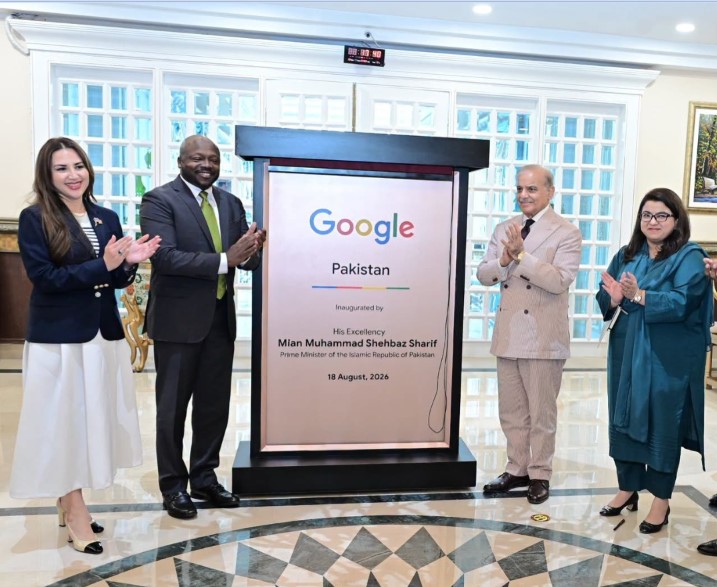
The formal inauguration of Google’s Pakistan office was marked by a plaque-unveiling ceremony, jointly conducted by Prime Minister Shehbaz Sharif, Google Vice President Wilson White, U.S. Chargé d’Affaires Natalie Baker, and other senior dignitaries in attendance. The ceremony was widely covered by local media and shared across official government channels, including the Prime Minister’s official Facebook page.
The event brought together senior representatives from government, the private technology sector, and the diplomatic community, reflecting the multi-stakeholder interest in Pakistan’s digital growth trajectory.
Why This Matters for Pakistan’s Digital Economy
Pakistan’s technology and IT services sector has emerged as one of the country’s fastest-growing export industries in recent years, with software development, freelancing, and business process outsourcing contributing significantly to foreign exchange earnings. The establishment of Google’s physical office in Islamabad is expected to serve as a catalyst for further growth in this space by:
- Strengthening local partnerships between Google and Pakistani government institutions, universities, and private-sector companies.
- Expanding training and upskilling programs in high-demand fields such as AI, cloud computing, and mobile app development.
- Supporting small and medium enterprises (SMEs) in leveraging Google’s tools to reach international customers and markets.
- Creating direct and indirect employment opportunities for young professionals across the technology value chain.
- Boosting investor confidence in Pakistan’s digital infrastructure and regulatory environment.
Analysts note that formal, on-ground presence by a company of Google’s scale often precedes deeper structural investment, including localized product support, developer ecosystems, and expanded partnerships with local telecom and fintech players.
Pakistan’s IT Business Landscape: A Sector Coming of Age
Pakistan’s IT business ecosystem has evolved rapidly over the past decade, moving from a niche outsourcing hub to a genuine pillar of the national economy. Thousands of registered software houses, freelance platforms, BPO (business process outsourcing) firms, and startups now operate across cities such as Islamabad, Lahore, Karachi, and Peshawar, supported by government bodies like the Pakistan Software Export Board (PSEB) and Ignite National Technology Fund. Technology parks and incubation centers have expanded across the country, creating dedicated ecosystems where entrepreneurs, freelancers, and established companies can access infrastructure, mentorship, and international market linkages.
This growing IT business base has increasingly attracted the attention of global technology firms, and Google’s decision to formally establish an office in Pakistan fits within this broader pattern. A local presence typically allows companies like Google to engage more directly with domestic developers, startups, and small businesses — offering training, certification programs, and direct support that were previously accessible only through remote or regional channels. For Pakistani entrepreneurs looking to scale internationally, this kind of on-ground partnership can significantly shorten the distance between local innovation and global markets.
IT Exports Data: A Record-Breaking Fiscal Year
Pakistan’s digital economy credentials are increasingly backed by hard export numbers. According to the State Bank of Pakistan’s Balance of Payments data, the country’s IT exports climbed to a record $4.600 billion in fiscal year 2025-26, extending the sector’s strong growth trajectory and reinforcing its position as the country’s largest services export. This represented a 20 percent, or $786 million, year-on-year rise from $3.814 billion in FY25, even though exports still fell around $400 million short of the government’s $5 billion target.
The monthly trend was equally telling. Exports reached $416 million in June alone, the highest monthly earnings of the fiscal year, up 22.7 percent from $339 million a year earlier and 11.5 percent higher than May’s $373 million. IT Minister Shaza Fatima Khawaja noted that the government recorded an ICT trade surplus of $3.9 billion for the year, up 18 percent compared to FY2024-25 — underlining that the sector is not only exporting more, but doing so profitably, with limited import dependency.
Independent data compiled by the Pakistan Bureau of Statistics tells a similar story of sustained expansion, with officials noting the IT sector’s export base has broadened well beyond traditional client geographies. Pakistani SMBs are actively expanding beyond the US and Europe into key Asia-Pacific hubs like Japan and Singapore, diversifying the country’s client base and reducing reliance on any single regional market. Government survey data further shows that ICT export remittances grew broadly across the year, supported by expansion of technology parks, human capital development, and technology adoption programmes run through PSEB and Ignite covering artificial intelligence, semiconductor design, startup incubation, and freelancing.
These figures matter beyond the balance sheet. As traditional export sectors such as textiles face global headwinds, IT and IT-enabled services have emerged as one of Pakistan’s most reliable and fastest-growing sources of foreign exchange — a trend that officials say strengthens the case for deeper partnerships with global technology leaders like Google.
Digital Economy Prospects: What Lies Ahead
Looking beyond the current fiscal year, Pakistan’s digital economy prospects appear increasingly tied to policy continuity, skills development, and international partnerships of exactly the kind formalized through Google’s new office. A major policy milestone came with the approval of Pakistan’s Artificial Intelligence Policy 2025, which aims to accelerate AI adoption, encourage innovation, strengthen skills development, and promote digital transformation across key sectors of the economy.
Industry observers expect this policy momentum, combined with expanding freelance participation and rising global demand for outsourced digital services, to keep pushing export figures higher in the coming years. The government’s stated ambition to cross the $5 billion IT export mark — narrowly missed in FY2025-26 — remains firmly on the table, with officials citing continued diversification into APAC markets, gaming, cloud services, and AI-enabled products as key growth levers.
For this trajectory to hold, sustained investment in digital skills will be essential. This is precisely where Google’s expanded local commitment is expected to play a role — through upskilling programs targeted at students, freelancers, and small business owners, designed to keep Pakistan’s workforce competitive as global demand shifts toward AI literacy, cloud computing, and advanced software engineering.
A New Era of Digital Pakistan
Taken together, the inauguration of Google’s Pakistan office, the government’s “Digital Nation Pakistan” vision, and record-breaking IT export performance point toward what officials and industry stakeholders are increasingly describing as a new era of digital Pakistan. Rather than treating technology as a peripheral policy area, the government has positioned digital transformation as central to its broader economic strategy — spanning governance reform, export diversification, foreign investment, and youth employment.
The presence of a global technology leader like Google on the ground in Islamabad is likely to accelerate this shift in several tangible ways: faster rollout of localized digital tools, closer collaboration with regulators on data and AI policy, expanded access to Google’s global developer and business ecosystems for Pakistani firms, and a stronger pipeline of trained talent ready to serve both domestic and international markets. If sustained, this convergence of policy, private investment, and export momentum could mark a genuine turning point for Pakistan’s digital economy over the next several years.
Conclusion: Empowering Youth Through Technology and Global Partnership
The inauguration of Google’s Pakistan office represents more than a symbolic milestone — it signals a tangible commitment by one of the world’s leading technology companies to invest in Pakistan’s digital future. At the heart of this partnership lies a shared vision: empowering Pakistan’s youth through modern tools, techniques, and technology.
As Prime Minister Shehbaz Sharif noted, this collaboration is envisioned as a long-term journey rather than a one-off engagement — one aimed at equipping young Pakistanis with the digital skills needed to compete on a global stage, from artificial intelligence and IT to the rapidly growing gaming industry. For a country where a majority of the population is under 30, such partnerships carry the potential to transform not just individual livelihoods, but the broader trajectory of Pakistan’s economy.
With the “Digital Nation Pakistan” vision now backed by concrete international partnerships, and with Google committing to scale up its upskilling and employment-generation programs, Pakistan’s digital transformation appears poised to enter a new, more ambitious phase — one built on collaboration, innovation, and the empowerment of its youngest and largest resource: its people.
Source: Prime Minister’s Office / Official Facebook page of PM Shehbaz Sharif (facebook.com/ShehbazSharif)