World leaders to Converge in Bishkek for the SCO Summit 202
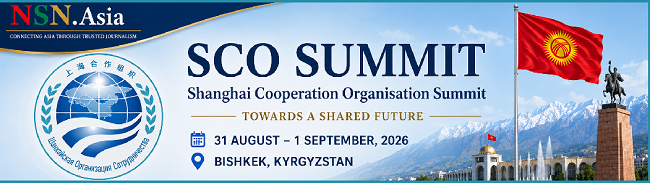
World leaders including China's Xi Jinping and Russia's Vladimir Putin converge on Bishkek for the SCO Summit 2026, as the bloc marks 25 years of advancing Eurasian security, economic cooperation, and regional connectivity.

-
World leaders to Converge in Bishkek for the SCO Summit 202
-
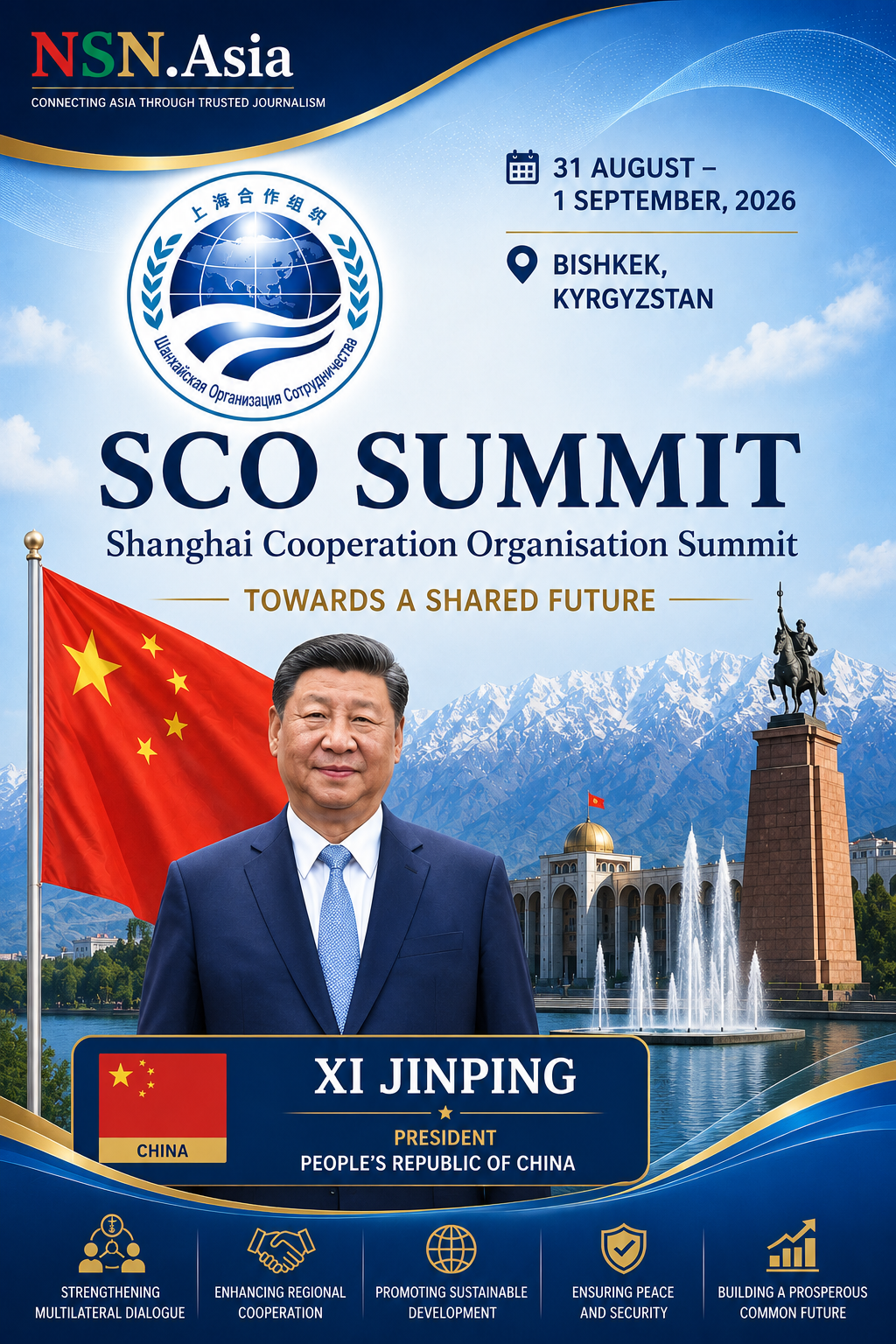
World leaders including China’s Xi Jinping and Russia’s Vladimir Putin converge on Bishkek for the SCO Summit 2026, as the bloc marks 25 years of advancing Eurasian security, economic cooperation, and regional connectivity.
-
The Shanghai Cooperation Organization marks a quarter-century of security, economic, and connectivity cooperation
By: Muhammad Arif, Editor NSN.Asia
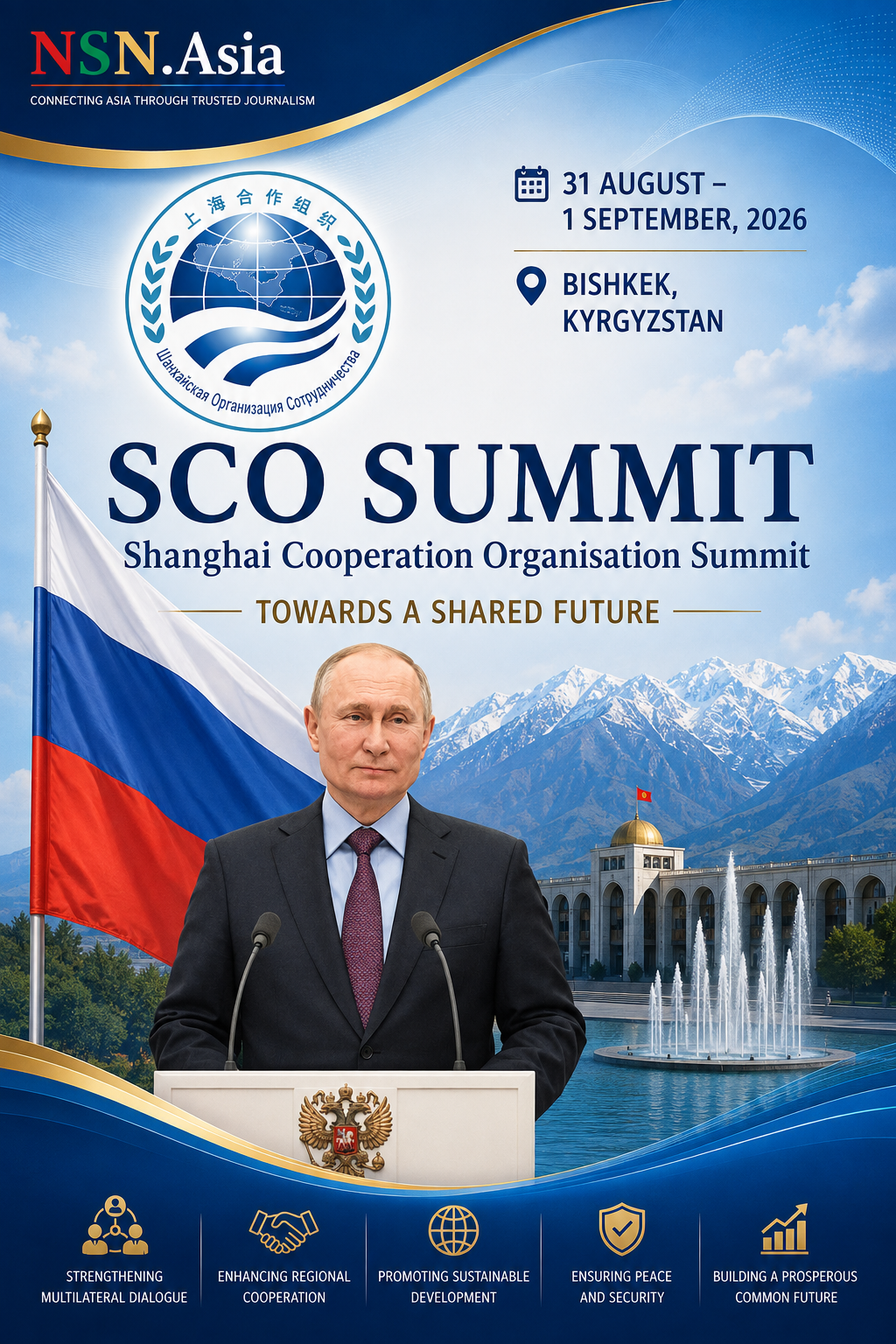
Bishkek is set to take center stage in Eurasian diplomacy as it hosts the 2026 Shanghai Cooperation Organization (SCO) Summit, drawing top leaders — including Chinese President Xi Jinping, Russian President Vladimir Putin, and heads of state from across the bloc’s ten-member roster — for three days of talks on regional security, economic integration, and connectivity. The gathering lands at a symbolic moment, coinciding with the SCO’s 25th anniversary, and positions Kyrgyzstan as a pivotal convening ground for a region that stretches from South Asia through Central Asia to the Middle East and Eastern Europe.
A Gathering of Top Leaders
Among the marquee arrivals is President Xi Jinping, who will travel to Kyrgyzstan on a state visit at the invitation of President Sadyr Japarov ahead of the summit proceedings. Kyrgyzstan’s presidential administration has indicated that bilateral talks will center on deepening the strategic partnership between Beijing and Bishkek, with several interstate and intergovernmental agreements expected to be finalized during the visit.
Xi will be joined by President Vladimir Putin of Russia and fellow leaders from across the SCO’s expanding membership — a bloc that now spans China, Russia, Kazakhstan, Kyrgyzstan, Tajikistan, Uzbekistan, India, Pakistan, Iran, and Belarus. Their presence together in one setting underscores what has become one of the SCO’s defining features: a platform where countries with real and sometimes unresolved tensions — from the China-India border dispute to India-Pakistan relations and Iran’s position under international sanctions — continue to engage through a shared multilateral structure.
Beyond the summit itself, Xi is also expected to take part in the opening ceremony of the 6th World Nomad Games, lending the visit a cultural dimension alongside its diplomatic weight.
Eurasian Security and Economic Cooperation on the Agenda
The 2026 summit’s agenda reflects how far the SCO has evolved since its founding as a narrow security mechanism. Leaders are expected to address:
- Regional security coordination, including counterterrorism cooperation and confidence-building measures among member states
- Economic cooperation, with continued momentum behind trade facilitation and a long-discussed SCO development bank
- Regional connectivity, including transport corridors and infrastructure linking Central Asia to broader Eurasian trade routes
- Cultural exchange, reinforced by the concurrent World Nomad Games celebrating the region’s shared heritage
For host nation Kyrgyzstan, the summit is also a venue to press its own priorities — deeper trade ties, cross-border infrastructure, and continued investment from major partners like China and Russia.
Kyrgyzstan’s Moment as Host
Hosting a summit of this scale is a rare distinction for Kyrgyzstan, a country of roughly seven million people not typically at the center of major-power diplomacy. For President Japarov’s government, welcoming leaders like Xi and Putin to Bishkek offers a platform to reinforce Kyrgyzstan’s standing within Central Asia and strengthen bilateral relationships across the SCO’s growing membership. Pairing the summit with the World Nomad Games allows Kyrgyzstan to present both its diplomatic ambitions and its cultural identity on the same global stage.
Backgrounder: The Shanghai Cooperation Organization at 25
The SCO was formally established in 2001, growing out of the “Shanghai Five” mechanism formed in the 1990s by China, Russia, Kazakhstan, Kyrgyzstan, and Tajikistan to ease border tensions among post-Soviet neighbors. Over the past quarter-century, it has expanded into a ten-member bloc spanning South Asia, Central Asia, the Middle East, and Eastern Europe, with India and Pakistan joining in 2017, Iran in 2023, and Belarus in 2024.
Its mandate has grown well beyond its original security focus to include:
- Security cooperation — counterterrorism coordination and confidence-building among members
- Economic cooperation — trade facilitation, connectivity projects, and a proposed development bank
- Cultural cooperation — exchange programs and joint cultural initiatives across the region
Conclusion
As Bishkek welcomes Xi Jinping, Vladimir Putin, and fellow heads of state, the 2026 SCO Summit marks both a milestone and a test: 25 years after its founding as a modest border-security arrangement, the organization now represents one of Eurasia’s most significant multilateral platforms, encompassing a substantial share of the world’s population and economic output. The summit’s focus on security, economic cooperation, and regional connectivity reflects the SCO’s evolution — and Kyrgyzstan’s growing role as a convening point for a region navigating both cooperation and unresolved rivalries under one roof.