Bishkek Prepares to Welcome Eurasia’s Most Influential Leaders as SCO Turns 25
Bishkek readies for the SCO Heads of State Summit as leaders including China's Xi Jinping, Rusia's President Putin who gather in capital city to mark the bloc's 25th anniversary and chart Eurasia's next chapter in security and economic cooperation.

-
Bishkek Prepares to Welcome Eurasia’s Most Influential Leaders as SCO Turns 25
-
As the Shanghai Cooperation Organization marks 25 years, Kyrgyzstan steps into the spotlight as host of a summit bringing together leaders from ten member states across Eurasia
-
Bishkek readies for the SCO Heads of State Summit as leaders including China’s Xi Jinping, Rusia’s President Putin who gather in capital city to mark the bloc’s 25th anniversary and chart Eurasia’s next chapter in security and economic cooperation.
-
By: Muhammad Arif, Editor NSN.Asia
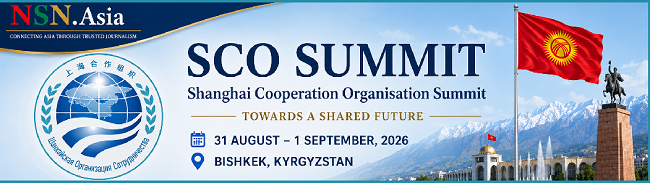
Bishkek , the capital city, is in full preparation mode this week as the Kyrgyz capital readies to host the Shanghai Cooperation Organization’s (SCO) Council of Heads of State summit, a gathering that will draw presidents and senior officials from across South Asia, Central Asia, the Middle East and Eastern Europe. The three-day event marks one of the most significant diplomatic moments in Kyrgyzstan’s recent history, placing the country at the center of Eurasian geopolitics even as unresolved tensions among several member states simmer just beneath the surface of the formal agenda.
Who’s Attending
Chief among the visiting dignitaries is Chinese President Xi Jinping, who will arrive in Kyrgyzstan on August 30 for a state visit at the invitation of President Sadyr Japarov, ahead of his participation in the SCO summit itself. According to Kyrgyzstan’s presidential administration, talks between the two leaders will focus on deepening the strategic partnership between Bishkek and Beijing, with a number of interstate, intergovernmental, and interdepartmental agreements expected to be signed following the visit.
Xi’s itinerary in Bishkek extends beyond the summit hall. In addition to joining the Council of Heads of State meeting, he is set to take part in the opening ceremony of the 6th World Nomad Games, a cultural and sporting event that has become a signature showcase of Central Asian heritage.
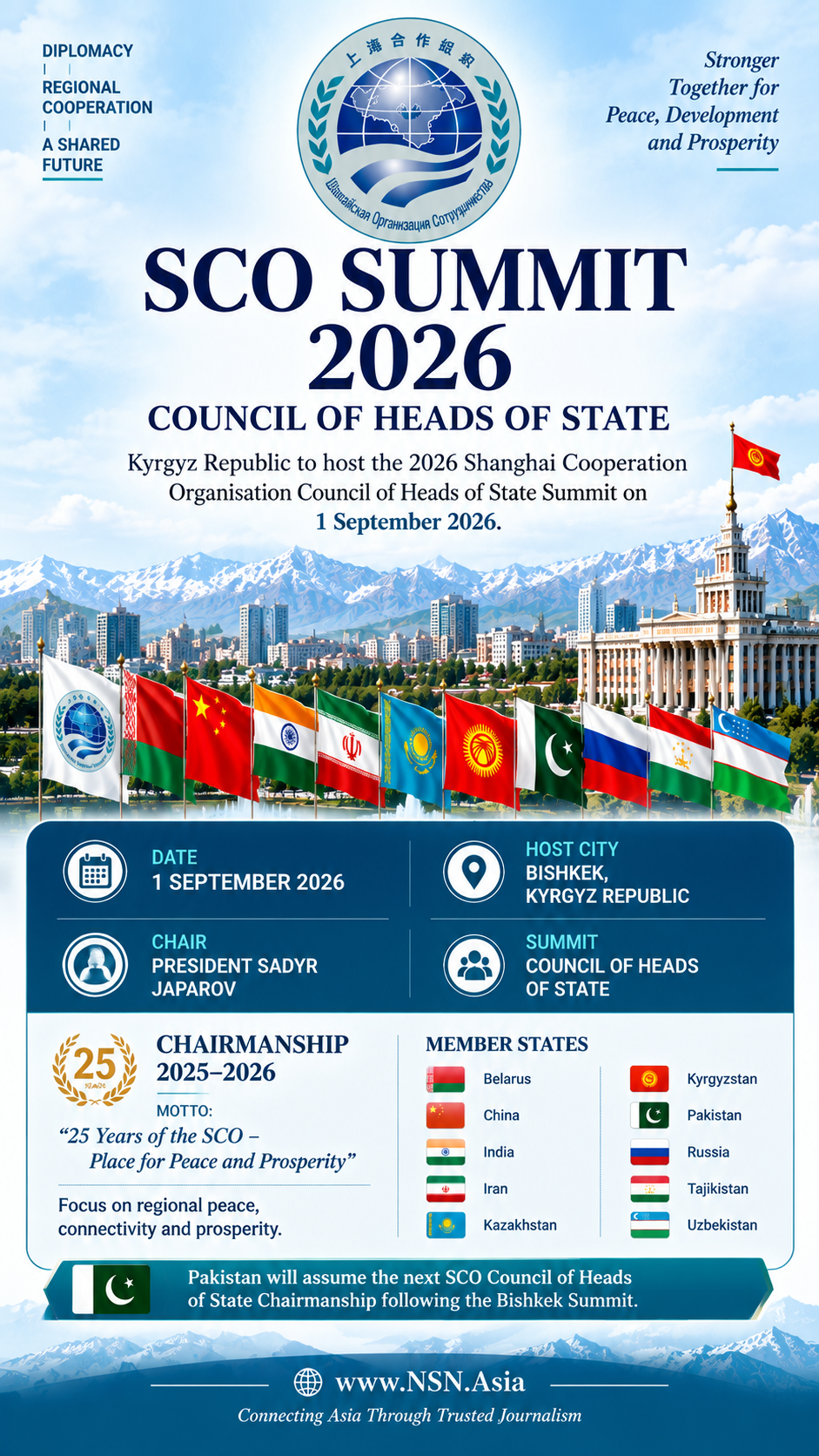
Xi will be joined in Bishkek by fellow heads of state from across the ten-member bloc, whose expanding roster now includes India and Pakistan (admitted in 2017), Iran (2023), and Belarus (2024) — alongside founding and long-standing members Russia, Kazakhstan, Tajikistan, and Uzbekistan. That breadth of membership means the summit doubles as a rare room where countries with active or recent friction — China and India over their disputed border, India and Pakistan over long-standing regional disputes, and Iran amid ongoing international sanctions pressure — sit at the same table under a shared multilateral framework.
The Summit’s Agenda
While the headline moment is the Council of Heads of State meeting, the Bishkek summit’s agenda reflects how far the SCO’s mandate has traveled from its original, narrowly defined purpose. Discussions are expected to span:
- Security coordination, including counterterrorism cooperation, a founding pillar of the organization
- Economic integration, with continued discussion of connectivity infrastructure, trade facilitation, and a long-proposed SCO development bank
- Cultural and people-to-people exchange, underscored by the concurrent World Nomad Games
- Bilateral diplomacy on the sidelines, as member states use the gathering to advance individual relationships — as seen in the China-Kyrgyzstan state visit bookending the summit
For Kyrgyzstan, the agenda is also an opportunity to press its own priorities: regional transport corridors, cross-border trade, and continued investment from larger SCO partners like China.
Kyrgyzstan’s Role as Host
Hosting the SCO summit is a significant moment for Kyrgyzstan, a country of roughly seven million people that rarely finds itself at the center of major-power diplomacy. For Bishkek, the summit offers a chance to project stability and diplomatic capability on a global stage, while strengthening bilateral ties with heavyweight partners — most notably China, whose head of state is arriving for a dedicated state visit built directly around the summit dates.
President Sadyr Japarov’s government has framed the summit as a chance to reinforce Kyrgyzstan’s standing within Central Asia and its broader relationships across the SCO’s expanding membership. The pairing of the summit with the World Nomad Games — a festival celebrating traditional Central Asian sport and culture — also allows Kyrgyzstan to present its cultural identity alongside its diplomatic ambitions, blending hard geopolitics with soft-power outreach.
News Backgrounder: What Is the Shanghai Cooperation Organization?
The Shanghai Cooperation Organization was formally founded in 2001, evolving out of the “Shanghai Five” mechanism established in the 1990s by China, Russia, Kazakhstan, Kyrgyzstan, and Tajikistan to ease border tensions and resolve territorial disputes among post-Soviet neighbors. What began as a narrow security-focused arrangement has since grown into a ten-member bloc spanning South Asia, Central Asia, the Middle East, and Eastern Europe.
Membership now includes China, Russia, Kazakhstan, Kyrgyzstan, Tajikistan, Uzbekistan, India, Pakistan, Iran, and Belarus — with India and Pakistan joining in 2017, Iran in 2023, and Belarus in 2024.
Mandate: The SCO’s scope has broadened well beyond its original security remit to encompass:
- Security cooperation, including coordinated counterterrorism efforts and confidence-building measures among member states
- Economic cooperation, including trade facilitation, connectivity projects, and discussions around a proposed SCO development bank
- Cultural cooperation, including exchange programs and joint cultural events across the region
The organization’s growth has made it a distinctive fixture in global diplomacy: a multilateral platform where countries with genuine, sometimes active tensions — from the China-India border dispute to India-Pakistan relations to Iran’s standing under international sanctions — continue to engage within a shared institutional framework.

Conclusion
This year’s summit in Bishkek arrives at a symbolic juncture: the SCO’s 25th anniversary since its founding in 2001. What started as a modest border-security mechanism among five post-Soviet states has grown into one of Eurasia’s most consequential multilateral platforms, now encompassing a third of the world’s population and a significant share of global economic output. As Kyrgyzstan welcomes Xi Jinping and fellow heads of state to Bishkek, the summit stands as both a marker of the SCO’s expanding influence and a test of its founding premise — that dialogue and cooperation across security, economic, and cultural lines can hold together a bloc whose members don’t always see eye to eye. For Kyrgyzstan, the moment underscores its role in regional connectivity and its growing relevance as a convening point for Eurasian cooperation.