CooperationNewsNSNPakistan-China CooperationPhotosSilk RoadSouth Asia

CPEC 2.0: President Zardari Calls for Integrated Development of Keti Bunder Port

President Asif Ali Zardari meets Chinese CHEC delegation on Keti Bunder Port's $522M master plan, urging connectivity, local livelihoods and Indus Delta protection under CPEC.

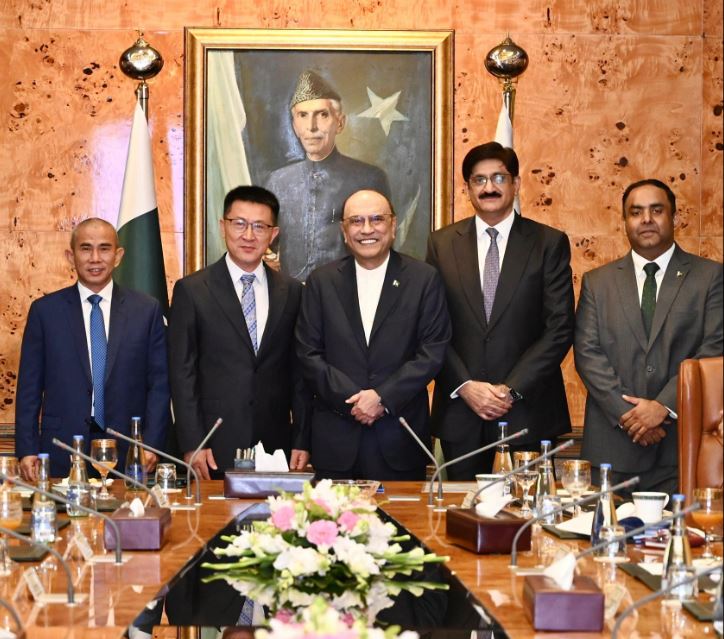
  • CPEC 2.0: President Zardari Calls for Integrated Development of Keti Bunder Port

  • For CPEC 2.0 Development plan,  President Asif Ali Zardari meets Chinese CHEC delegation on Keti Bunder Port’s $522M master plan, urging connectivity, local livelihoods and Indus Delta protection .

  • CHEC Presents Conceptual Master Plan Worth $522 Million

By: Muhammad Arif, Editor NSN.Asia
Islamabad, August 24, 2026: President Asif Ali Zardari has called for an integrated approach to the proposed development of Keti Bunder Port, stressing that the project must be backed by reliable road connectivity, uninterrupted power and water supply, industrial infrastructure and other essential facilities to realize its full economic potential.
President Calls for Integrated Development of Keti Bunder Port with Focus on Connectivity, Local Livelihoods NSN Asia 2026
President Calls for Integrated Development of Keti Bunder Port with Focus on Connectivity, Local Livelihoods. NSN Asia 2026
The President’s remarks came during a high-level presentation on the proposed development of Keti Bunder Port, delivered by a delegation from China Harbour Engineering Company (CHEC) at the Presidency in Islamabad. Welcoming the visiting Chinese delegation, President Zardari appreciated China’s sustained interest in supporting Pakistan’s infrastructure and maritime development, describing it as a reflection of the enduring strength of Pakistan-China relations under the broader framework of the China-Pakistan Economic Corridor (CPEC).
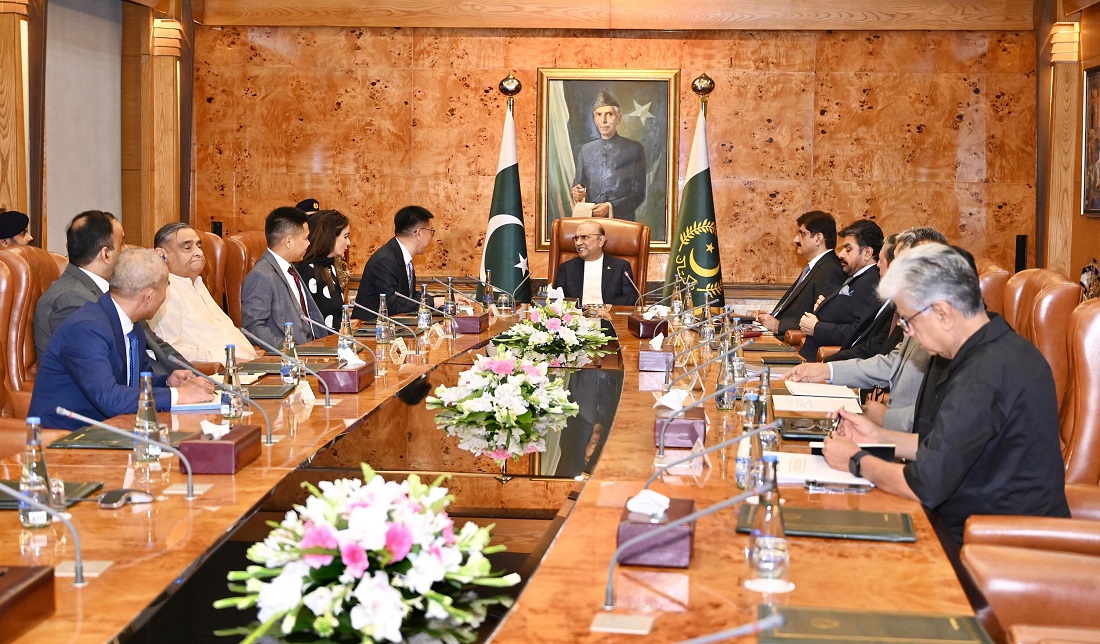
President Calls for Integrated Development of Keti Bunder Port with Focus on Connectivity, Local Livelihoods NSN Asia 2026
Keti Bunder: A New Maritime Gateway for Pakistan
Addressing the delegation, President Zardari said Keti Bunder held significant potential as an additional maritime gateway that could strengthen Pakistan’s port and logistics network and support greater regional connectivity and trade. Located in the Indus Delta region of Sindh, Keti Bunder has long been identified as a strategically located site for a new deep-water port that could ease congestion at Karachi and Port Qasim while opening fresh trade and investment corridors along Pakistan’s southern coastline.
The President emphasised the need for close technical coordination between the Chinese side and relevant Pakistani authorities to ensure the project moves forward on sound engineering, financial and environmental foundations. He noted that a project of this scale required careful planning that goes beyond the port infrastructure itself, extending to the surrounding ecosystem of roads, utilities and industrial support that would make the port commercially viable and sustainable in the long run.
Environmental Sustainability and Local Livelihoods a Priority
A key theme of the President’s remarks was the protection of the environment and the communities that depend on it. He stressed that environmental sustainability must remain a central consideration in the project’s design and execution, particularly given the ecological sensitivity of the Indus Delta — one of the largest delta ecosystems in the world and home to mangrove forests, diverse marine life and fishing communities that have relied on these waters for generations.
President Zardari specifically underlined the need to safeguard the interests and livelihoods of local fishing communities, urging that development plans be structured in a way that creates economic opportunities for residents rather than displacing them. He encouraged continued technical engagement between CHEC and Pakistani stakeholders to further refine the master plan and to identify an appropriate implementation and financing framework that balances commercial viability with social and environmental responsibility.
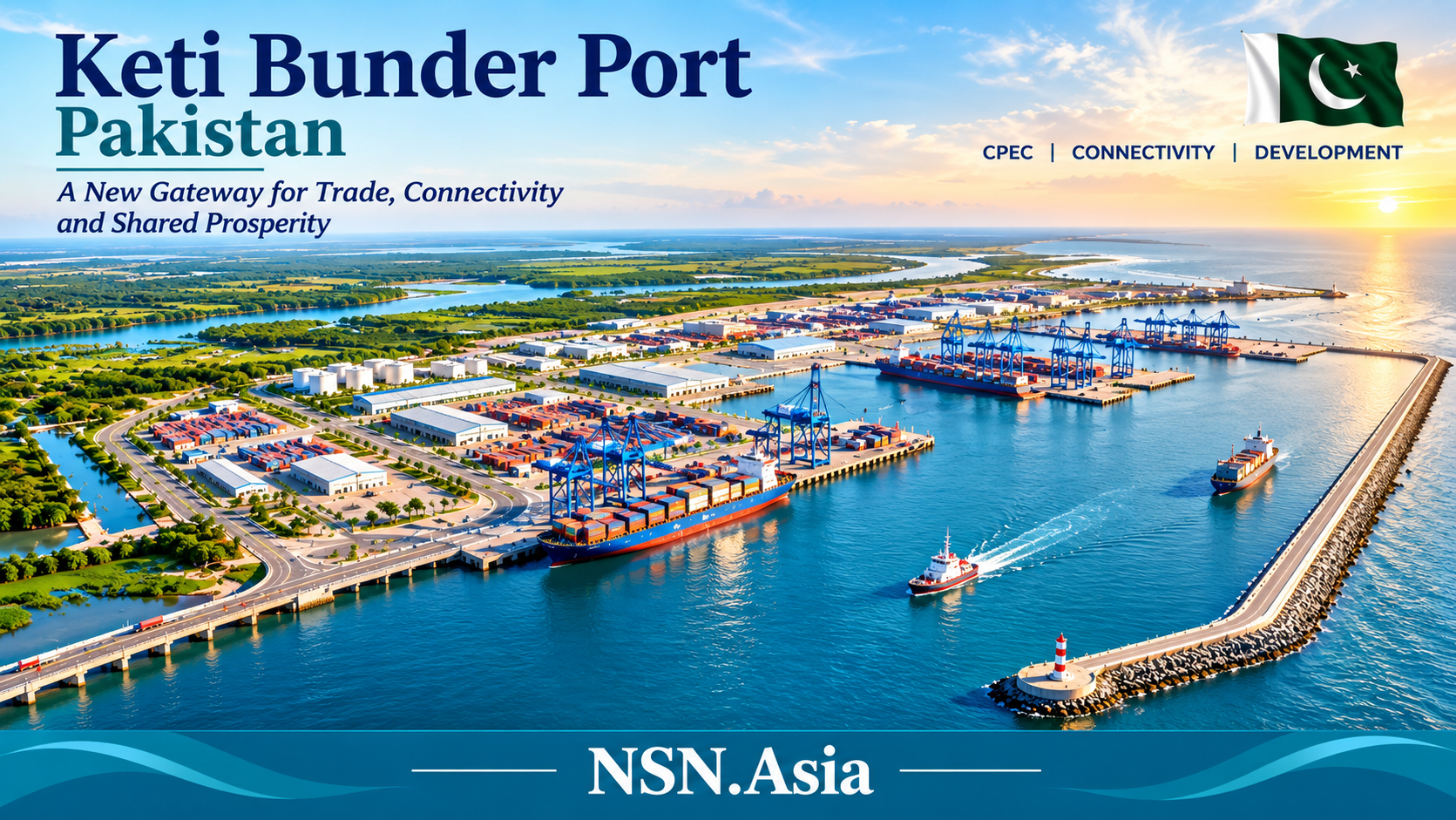
Chinese company CHEC Presents Conceptual Master Plan Worth $522 Million for Keti Bunder Port, Pakistan NSN Asai 2026
CHEC Presents Conceptual Master Plan Worth $522 Million
During the briefing, the Chinese delegation presented the Conceptual Master Plan for Keti Bunder Port, outlining a vision for a new deep-water maritime gateway comprising multiple terminals along with the logistics and supporting infrastructure needed to operate a modern commercial port.
According to details shared with the President, the proposed Phase-I development includes a multi-purpose terminal featuring a 500-metre quay, with a preliminary engineering cost estimate of approximately US$522.34 million. The delegation indicated that the phased approach would allow the port to scale up progressively, with future phases expanding capacity in line with trade demand and investor interest.
The Chinese delegation comprised Mr Wu Ping, Chief Representative of CHEC in Pakistan; Mr Wang Zongde, Head of Marketing Department; and Mr Xu Tielin, Engineer, along with Mr Ali Raza, General Manager of Strategy and Marketing.
Senior Sindh and Federal Leadership in Attendance
The meeting was attended by senior leadership from both the federal and Sindh governments, underscoring the project’s strategic importance. Those present included Sindh Chief Minister Syed Murad Ali Shah, Senators Saleem Mandviwala and Sherry Rehman, Sindh Minister for Energy and Planning & Development Mr Nasir Hussain Shah, Special Assistant to the Chief Minister for Investment & Public Private Partnership Syed Qasim Naveed Qamar, and Chief Secretary Sindh Syed Asif Hyder Shah.
The presence of top Sindh officials alongside federal leadership signals close coordination between the two tiers of government as the project moves from concept to feasibility and, eventually, implementation.
News Backgrounder: CPEC 2.0  and Pakistan’s Maritime Development
The China-Pakistan Economic Corridor (CPEC), launched in 2015 as a flagship project under China’s Belt and Road Initiative, has been central to Pakistan’s infrastructure development over the past decade, encompassing energy projects, road networks, industrial zones and port development. Gwadar Port, developed by China Overseas Port Holding Company, has been the most prominent maritime component of CPEC to date, positioned as a strategic transshipment hub linking Western China to global trade routes via the Arabian Sea.
The proposed development of Keti Bunder Port represents a potential expansion of Pakistan’s maritime ambitions beyond Gwadar, adding another deep-water facility along the Sindh coastline. Analysts note that a diversified port network — spanning Karachi, Port Qasim, Gwadar and potentially Keti Bunder — could strengthen Pakistan’s position as a regional logistics and trade hub, while also generating employment and economic activity in coastal communities that have historically remained underdeveloped.
China Harbour Engineering Company (CHEC), a subsidiary of China Communications Construction Company (CCCC), has an established track record in Pakistan, having been involved in major port, road and marine infrastructure projects, including work related to Gwadar Port’s development.
Conclusion: Balancing Growth with Community and Ecology
As discussions on Keti Bunder Port move forward, the President’s emphasis on an integrated development model — one that pairs port infrastructure with connectivity, utilities and industrial support — reflects a broader recognition that large-scale maritime projects cannot succeed in isolation. For Keti Bunder to become a genuine driver of trade and regional growth, planners will need to reconcile ambitious engineering targets with the ecological realities of the Indus Delta and the livelihoods of the fishing communities who call it home.
The path ahead will likely involve detailed feasibility studies, environmental impact assessments and financing negotiations between Pakistani authorities and CHEC. If executed with the integrated, community-conscious approach President Zardari has called for, Keti Bunder Port could emerge as a meaningful addition to Pakistan’s maritime infrastructure — one that expands trade capacity while protecting the delta ecosystem and uplifting local communities that stand to be most directly affected by the project.

Reporting from Islamabad. Figures and statements are based on official briefing details shared during the President-CHEC meeting on August 24, 2026.

ARIF NSN

Muhammad Arif is a journalist repoting on Asian Affairs, with focus on connectivity in Eurasia. He holds Ph.D degree in Global Journalism from HBU, China, and teaches Journalism at a university in Islamabad. He is multilingual, speaks Eurasian languages—such as Chinese, Arabic, Spanish, Persian, and Russian —for his reporting assignments.
Back to top button