Green Economy Corridor Under CPEC Phase-II to Boost Pakistan–China Cooperation in Food Security
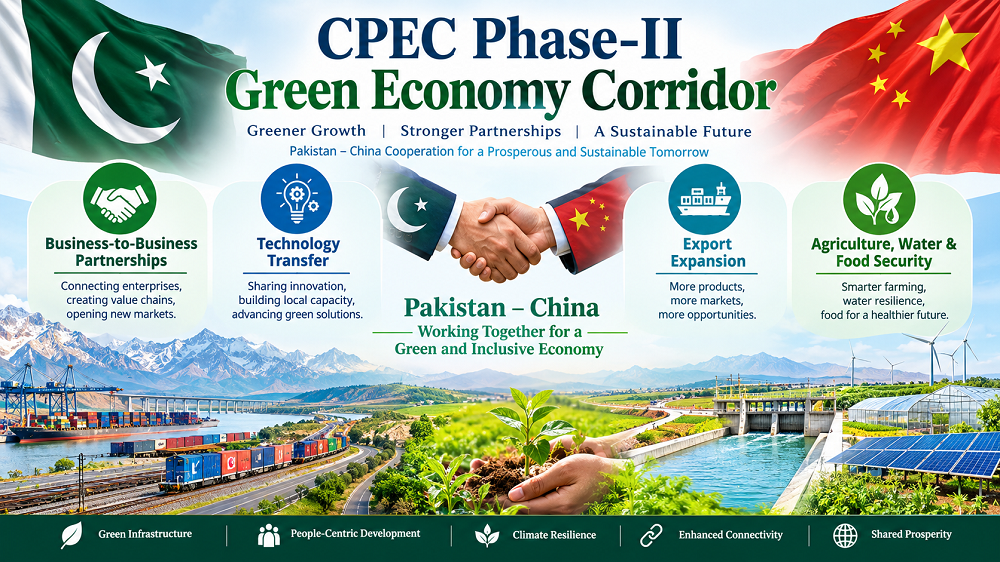
Federal Minister Prof. Ahsan Iqbal outlines the Green Economy Corridor under CPEC Phase-II, highlighting business-to-business partnerships, technology transfer, export expansion, and Pakistan–China cooperation on agriculture, water and food security

-
Green Economy Corridor Under CPEC Phase-II to Boost Pakistan–China Cooperation in Food Security
-
Federal Minister Prof. Ahsan Iqbal outlines the Green Economy Corridor under CPEC Phase-II, highlighting business-to-business partnerships, technology transfer, export expansion, and Pakistan–China cooperation on agriculture, water and food security
-
Ahsan Iqbal Calls for Stronger Private Sector Role, B2B Partnerships Under CPEC Phase-II
-
By: Muhammad Arif, Editor NSN.Asia
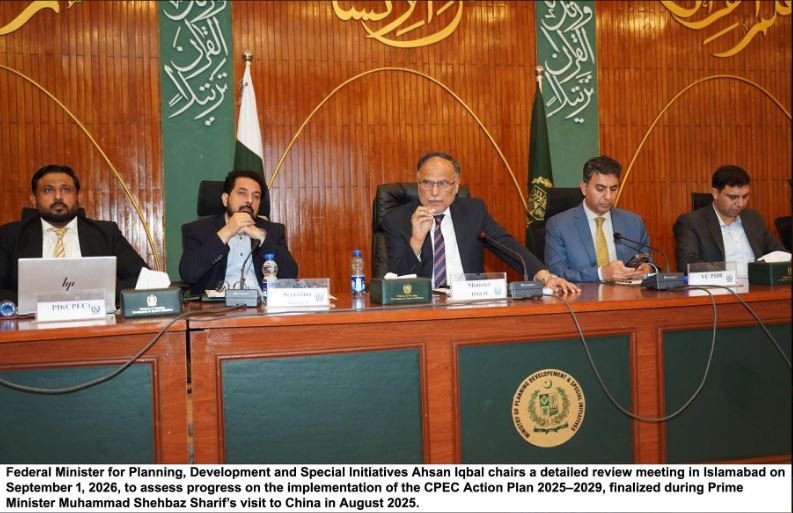
Islamabad: Federal Minister for Planning, Development and Special Initiatives, Prof. Ahsan Iqbal, has called for a greater role of the private sector in driving Pakistan’s economic growth, emphasizing business-to-business partnerships, technology transfer, competitive production and export expansion under CPEC Phase-II.
The Minister made these remarks during his opening address at a Review Meeting on the CPEC Action Plan 2025–2029, where he outlined the government’s strategic priorities for the next phase of Pakistan–China economic cooperation.
Exports as a “National Emergency”
Prof. Ahsan Iqbal stressed that exports must be treated as a national emergency, underscoring the urgency of expanding Pakistan’s export base to strengthen the country’s economic stability. He urged stronger collaboration between the government and the private sector, stating that such partnerships are essential to establishing “Made in Pakistan” as a globally recognized quality brand.
He noted that competitive production, backed by technology transfer and modern industrial practices, would be key to enabling Pakistani businesses to compete effectively in international markets. The Minister emphasized that CPEC Phase-II offers a critical opportunity to reposition Pakistan’s industrial and agricultural sectors for export-led growth, moving beyond traditional trade patterns toward higher-value, technology-driven production.
The Green Economy Corridor: A New Pillar of CPEC Phase-II
A central focus of the review meeting was the Green Economy Corridor under CPEC Phase-II, which is advancing cooperation with China on water security, food security and climate-resilient agriculture — priorities identified as key components of URAAN Pakistan, the national framework guiding the country’s economic transformation.
Officials highlighted that the Green Economy Corridor represents a significant evolution in the scope of Pakistan–China cooperation, extending beyond infrastructure and energy into sectors directly tied to Pakistan’s long-term food and water security. The initiative is designed to integrate Chinese agricultural technology, research capacity and modernization expertise with Pakistan’s agricultural sector, addressing structural challenges related to productivity, water use efficiency and climate vulnerability.
Training 1,000 Agricultural Experts in China
As part of this cooperation, Pakistan is training 1,000 agricultural experts in China, a move aimed at building the human capacity and technological base needed to support what officials have described as a “Green Revolution 2.0.” This next-generation agricultural transformation is expected to be driven by agri-tech innovations, improved seed varieties, farm mechanization and greater water efficiency.
Officials noted that this large-scale capacity-building initiative reflects the depth of Pakistan–China collaboration on agricultural modernization, positioning trained experts to introduce and scale up modern farming techniques across Pakistan’s agricultural sector. The initiative is expected to play a central role in improving productivity, reducing input wastage and strengthening resilience against climate-related shocks such as erratic rainfall, flooding and rising temperatures.
Aligning With URAAN Pakistan’s National Priorities
The Green Economy Corridor’s focus on water security, food security and climate-resilient agriculture directly supports the objectives outlined under URAAN Pakistan, the government’s flagship economic framework. By channeling Pakistan–China cooperation into these priority areas, officials aim to ensure that CPEC Phase-II delivers tangible benefits for Pakistan’s agricultural economy, which remains a critical contributor to national GDP, employment and rural livelihoods.
The review meeting also touched on the broader CPEC Action Plan 2025–2029, with officials reiterating the need for coordinated implementation across federal ministries, provincial governments and private sector stakeholders to ensure that the goals of the Green Economy Corridor are met within the designated timeframe.
Strengthening Agricultural Research and Climate Resilience
Officials at the meeting emphasized that strengthening agricultural research and developing climate-resilient crops will be critical to protecting Pakistan’s food security and agricultural productivity in a changing climate. With Pakistan ranked among the countries most vulnerable to climate change, the need for scientifically developed, resilient crop varieties has become increasingly urgent for sustaining agricultural output in the face of shifting weather patterns and resource constraints.
Collaboration with Chinese research institutions on crop science, seed technology and sustainable farming practices is expected to play a growing role in this effort, complementing domestic research initiatives and helping to future-proof Pakistan’s agricultural sector against climate-related disruptions.
The China–Pakistan Economic Corridor (CPEC), launched as a flagship project under China’s Belt and Road Initiative, has evolved from its initial focus on infrastructure and energy projects into a broader, more diversified partnership under CPEC Phase-II. This new phase places significant emphasis on industrial cooperation, agriculture, socio-economic development and the green economy, moving beyond large-scale construction to prioritize business-to-business partnerships, technology transfer, competitive production and export expansion. Central to this shift is the Green Economy Corridor, an initiative designed to align Pakistan–China cooperation with pressing national priorities such as water security, food security and climate resilience. These priorities are closely integrated with URAAN Pakistan, the government’s national economic transformation framework, which identifies agriculture modernization and export-led growth as key pillars for sustainable development. As Pakistan continues to grapple with the effects of climate change on its agricultural sector, cooperation with China on agri-tech, improved seed varieties, farm mechanization and water efficiency is increasingly viewed as essential to safeguarding long-term food security and productivity.
Conclusion
As Pakistan moves forward with the implementation of CPEC Phase-II, the continued promotion of Pakistan–China cooperation in agricultural productivity and food security must remain a top priority — particularly through sustained investment in agricultural research and the development of climate-resilient crops. The Green Economy Corridor offers a valuable framework for translating this cooperation into practical outcomes, from expanded agri-tech adoption to improved water efficiency and stronger export competitiveness. With 1,000 agricultural experts being trained in China and a clear policy alignment with URAAN Pakistan’s national priorities, the foundation for a Green Revolution 2.0 is being laid. Sustained government commitment, deeper private sector engagement, and expanded scientific collaboration between Pakistan and China will be essential to ensuring that this next phase of CPEC delivers lasting benefits for Pakistan’s food security, agricultural resilience and long-term economic growth.