

-
Solar Energy Revolution: The Sun and the Pipeline: A Policy Dialogue in Islamabad
-
Solar Energy Revolution: Parliamentarians and experts warn Pakistan against costly take-or-pay LNG deals as 50 GW of solar capacity reshapes the country’s energy landscape
By: Muhammad Arif, Editor NSN.Asia
Islamabad, August 27, 2026: Parliamentarians and energy experts have called upon the government to avoid long-term energy contracts that could trap Pakistan in costly take-or-pay obligations and contribute to circular debt, urging instead a more flexible approach towards LNG and other fuel imports as solar power rapidly reshapes the country’s energy landscape.
The call marks a significant moment in Pakistan’s energy policy debate, as the country grapples with the reality that its power sector is being transformed faster than official planning frameworks have been able to adapt — driven not by government mandate, but by ordinary consumers and businesses switching to solar in response to high tariffs and unreliable grid supply.
A Consumer-Led Solar Energy Revolution
In just a few years, and largely without public subsidy, Pakistan has deployed an estimated 50 GW of solar capacity across utility-scale projects, net-metered rooftop systems, agricultural applications, off-grid installations and behind-the-meter setups. This capacity is estimated to generate roughly 54.75 TWh annually — an output equivalent, on a gross energy basis, to nearly 1,279 MMCFD of gas-fired generation.
The scale of this deployment represents a structural transformation of Pakistan’s energy sector, one that has outpaced many of the assumptions underlying the country’s long-term gas and LNG commitments. Energy journalist and Energy Flux founder Seb Kennedy, speaking at a recent policy dialogue, described Pakistan as experiencing a consumer-led energy transition moving faster than the state’s planning system can adapt — driven by high tariffs, unreliable supply and falling solar costs rather than central planning.
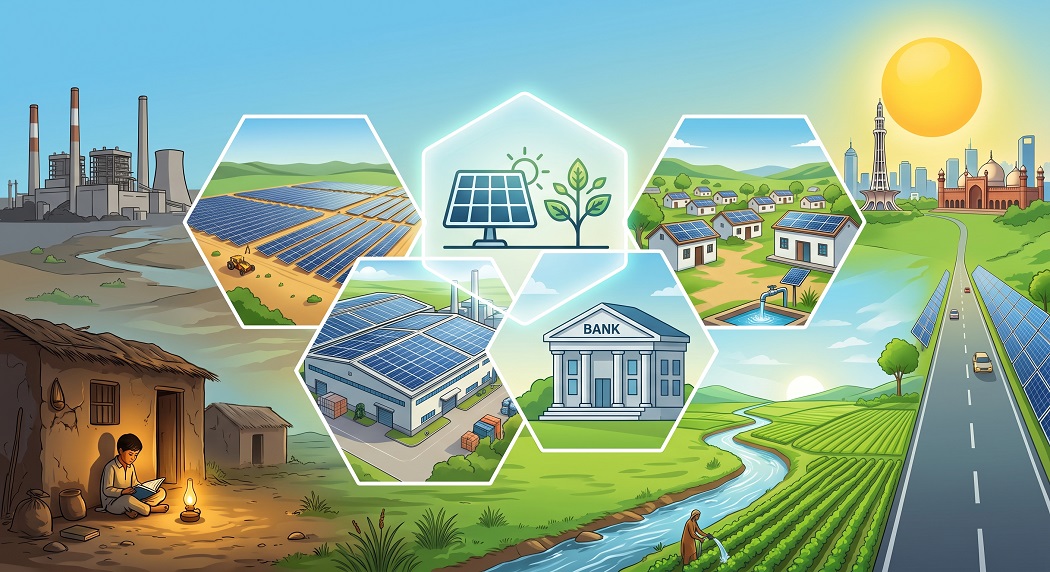
The Sun and the Pipeline: A Policy Dialogue in Islamabad
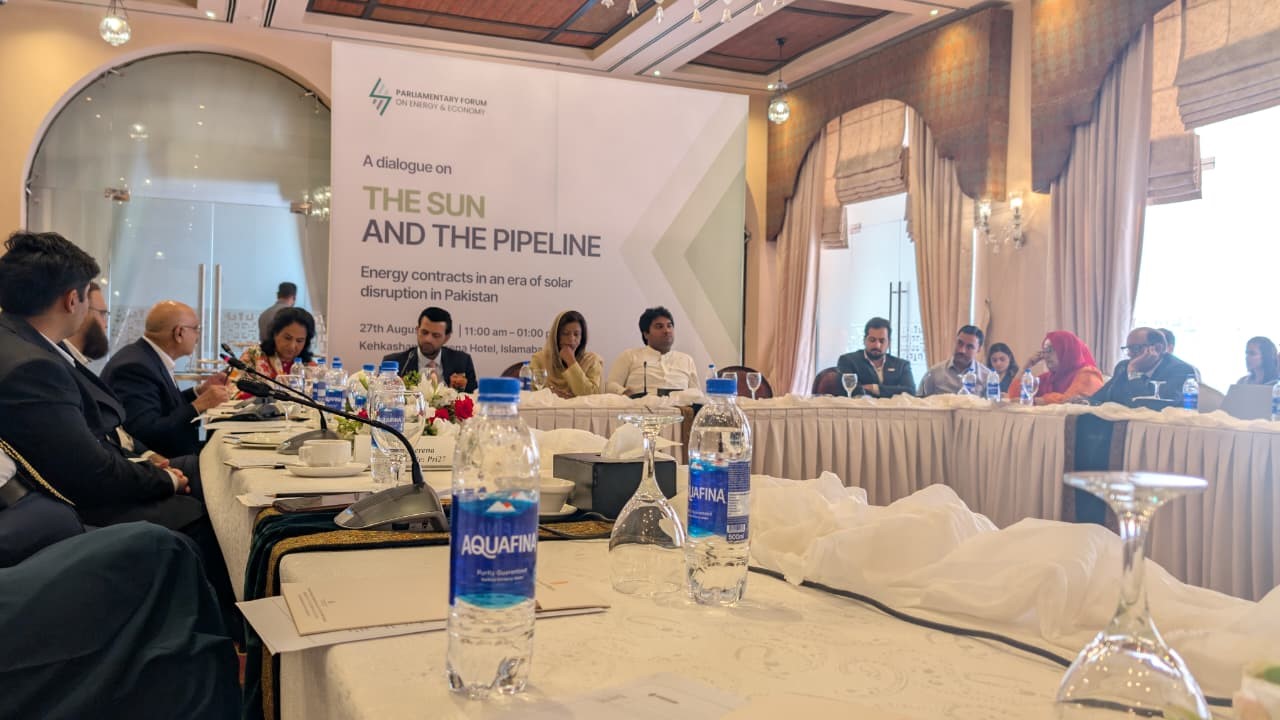
The discussion took place at a dialogue titled “The Sun and the Pipeline: Energy Contracts in an Era of Solar Disruption in Pakistan,” convened by the Parliamentary Forum on Energy and Economy at Serena Hotel, Islamabad. The dialogue examined Pakistan’s changing RLNG requirements, the impact of geopolitical risks and global market volatility, and policy options to protect consumers while maintaining energy security.
Dr. Nafisa Shah, Convener of the Parliamentary Forum on Energy and Economy and Member of the National Assembly, said Pakistan must rethink its energy mix and regulatory frameworks in light of the rapid deployment of solar power. “Pakistan has deployed an estimated 50 GW of solar capacity across its rooftops and other segments. Our energy policies must reflect this new reality and ensure that people finally receive the affordable energy they have missed for so long because of long-term take-or-pay contracts that have trapped us in prohibitively expensive electricity,” she said.
She added that the debate should not be framed as a binary choice: “We are not simply choosing solar over LNG. We are looking for a flexible, competitively priced energy layer that ensures security without penalizing the progress Pakistan has made in distributed generation.”
Moving Beyond a Sun-vs-Pipeline Debate
Barrister Danyal Chaudhry, Parliamentary Secretary for Information and Broadcasting and Secretary of the Parliamentary Forum on Energy and Economy, argued that the conversation should shift away from treating solar and gas as competing alternatives. “We should not ask whether Pakistan chooses the sun or the pipeline. We should ask how the sun, the pipeline, the grid and emerging technologies can work together to provide Pakistan with affordable, reliable and secure energy,” he said.
Muhammad Arif, former Member Gas at OGRA and a petroleum law, policy and regulatory advisor, emphasised the need to integrate energy governance and develop mechanisms to monetize surplus solar generation, particularly during periods of high solar output — a growing challenge as distributed solar capacity increasingly outpaces real-time grid demand at certain hours.
LNG Demand Is Changing, Not Disappearing
Asim Riaz, Energy Advisor at the All-Pakistan Textile Mills Association, said Pakistan’s LNG challenge was no longer solely about securing supply. “Pakistan’s LNG challenge is about demand, flexibility, affordability and market design. The sun has not eliminated the need for LNG. It has changed when RLNG is needed, how much is needed, and what kind of LNG portfolio Pakistan can afford,” he said.
This shift, experts noted, calls for restructuring how Pakistan procures gas — moving away from rigid, long-term volume commitments toward more adaptable contracts that can flex with seasonal and hourly solar output.

Structural Reform and Consumer Protection
Several speakers focused on the human and institutional dimensions of the transition. Huma Chughtai called for greater consistency and clarity in policymaking, particularly in understanding supply, demand and the wider challenges facing Pakistan’s economic and energy sectors, and stressed the need for stronger representation of the Planning Division in the policy process.
Mobeen Arif Jutt highlighted the burden of high electricity tariffs on ordinary citizens and stressed the need for meaningful structural reforms in the electricity sector, with particular attention to low-income and vulnerable communities who remain reliant on the grid and cannot easily switch to solar.
Syed Faizan Shah, Energy Expert and Advisor to the Power Minister, said Pakistan’s priority should not simply be adding more generation capacity. “Our focus is on building an energy system that is more resilient to external price shocks and more efficient across generation, transmission and distribution,” he said. “Expanding indigenous solar generation, supported by battery energy storage and other modern technologies, can improve system flexibility and reliability, reduce losses, optimize existing infrastructure and provide consumers greater protection against international fuel price fluctuations.”
The dialogue was attended by parliamentarians, energy experts, representatives of civil society and academia, reflecting the breadth of stakeholders now engaged in shaping Pakistan’s energy trajectory.
News Backgrounder: Pakistan’s Booming Solar Energy Sector
Pakistan’s solar sector has expanded dramatically over the past several years, evolving from a marginal contributor to the national energy mix into a major force reshaping electricity consumption patterns. Rising grid tariffs, frequent load-shedding in earlier years, and a sharp global decline in the cost of photovoltaic panels — driven largely by Chinese manufacturing capacity — have made rooftop and net-metered solar systems increasingly affordable for households, businesses and industrial consumers alike.
Unlike many of Pakistan’s earlier power-sector investments, which relied heavily on imported fuel and long-term government-backed contracts, this solar expansion has been largely consumer-driven, funded privately and deployed rapidly outside formal, centrally planned generation additions. This has created both opportunities and challenges: while it has reduced pressure on the national grid and cut consumer electricity bills, it has also disrupted demand forecasts that underpin existing long-term LNG and gas supply agreements, some of which carry binding take-or-pay obligations regardless of actual consumption.
The resulting mismatch — between falling grid-based demand for gas-fired power and existing long-term fuel import commitments — has become a central driver of Pakistan’s circular debt problem, prompting renewed calls from policymakers, industry and civil society for more flexible, market-responsive energy contracting.
Conclusion: A New Era Built on Sun and Pipeline Together
As Pakistan enters a new era of its energy story, the message emerging from policymakers and experts alike is clear: the country’s future does not lie in choosing between solar and LNG, but in intelligently combining them. Solar power has already proven its ability to deliver affordable, rapidly deployable energy at a scale few anticipated, while LNG and the pipeline network continue to provide the flexibility and reliability needed to balance a modernizing grid.
Together, with the support of battery storage and smarter market design, the sun and the pipeline hold the potential to reshape Pakistan’s energy landscape into one that is more affordable, resilient and secure — provided policymakers act swiftly to replace rigid, long-term contracts with a flexible framework built for this new reality.
Reporting from Islamabad. Details are based on proceedings of the dialogue “The Sun and the Pipeline: Energy Contracts in an Era of Solar Disruption in Pakistan,” convened by the Parliamentary Forum on Energy and Economy on August 27, 2026.