CooperationNSN
Pakistan, Türkiye, Azerbaijan Jointly Foster Political Cooperation
Pakistan, Türkiye, Azerbaijan Jointly Foster Political Cooperation, Trade, Connectivity

-
Pakistan, Türkiye, Azerbaijan Jointly Foster Political Cooperation, Trade, Connectivity
- By Muhammad Arif, Editor NSN.Asia
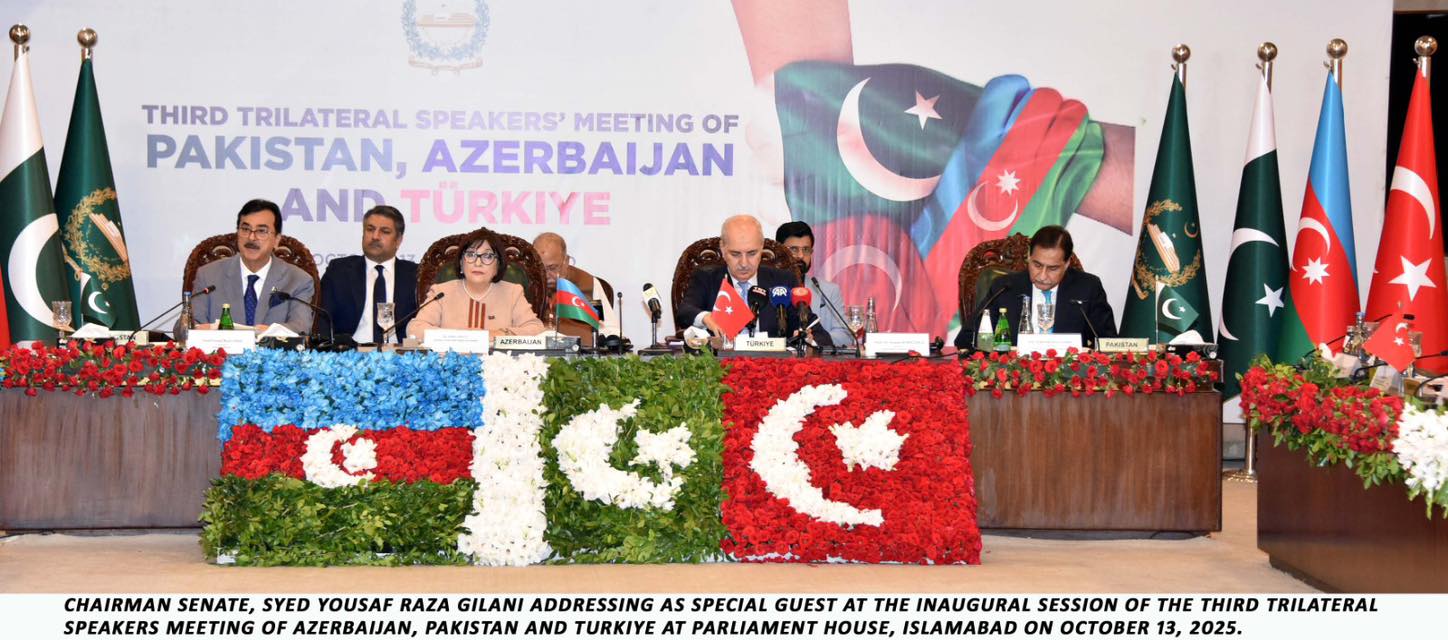
Islamabad, October 14 : Chairman Senate Syed Yousaf Raza Gilani has stressed the need for deeper political and parliamentary cooperation among Pakistan, Türkiye, and Azerbaijan, describing it as essential for achieving sustainable peace, security, and prosperity in the region.
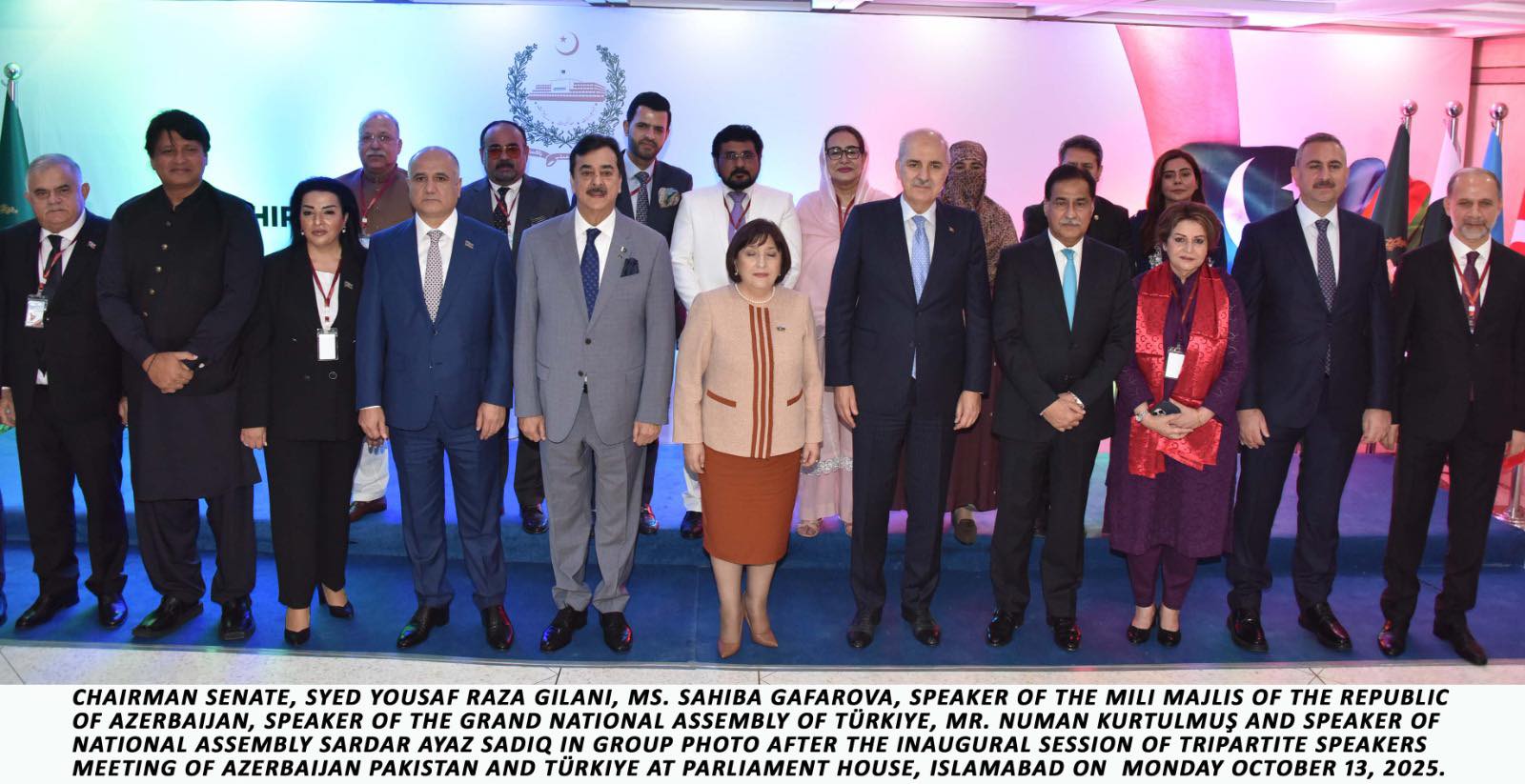
He made these remarks as Special Guest at the Third Tripartite Speakers’ Meeting of Azerbaijan, Pakistan, and Türkiye, held at the Parliament House, Islamabad on Monday. The event, themed “Strengthening Fraternal Ties: Parliamentary Cooperation for Regional Peace, Security and Prosperity,” brought together parliamentary leaders of the three brotherly nations.
Gilani emphasized that the partnership between the three countries must evolve from traditional friendship into structured political collaboration, particularly through parliamentary diplomacy.
“Our parliaments are not only voices of our people but instruments of political convergence. Together, we can transform shared values into shared policies,” he said.
Commending National Assembly Speaker Sardar Ayaz Sadiq for hosting the meeting, Gilani said the initiative demonstrates Pakistan’s commitment to promoting regional dialogue and cooperative engagement among Muslim-majority nations.
He reminded that Pakistan, Türkiye, and Azerbaijan have consistently supported each other’s core political causes — from Pakistan’s backing of Azerbaijan’s sovereignty, to Türkiye’s support for Kashmir’s self-determination, and the historic Khilafat Movement that first united Muslim nations under a shared political spirit.
“Our relationship is anchored in political trust, mutual respect, and cooperation. We have always stood shoulder to shoulder whenever justice called or sovereignty was challenged,” Gilani noted.
The Senate Chairman observed that the Muslim world faces serious political challenges, including in Palestine and Indian-occupied Kashmir, where collective parliamentary advocacy could serve as a moral and diplomatic force.
“These crises demand that our parliaments act as platforms of conscience, clarity, and courage,” he added.
Gilani urged the three nations to enhance cooperation in political dialogue, defense policy coordination, economic strategy, education, and cultural diplomacy, noting that inter-parliamentary exchanges could strengthen collective decision-making and representational power at the global stage.
He also briefed participants on the upcoming Inter-Parliamentary Speakers’ Conference (ISC) scheduled to be held in Islamabad next month, calling it a continuation of this trilateral vision of unity and political alignment.
“No nation can secure its future in isolation. Parliamentary cooperation is the political bridge that connects aspirations to action,” Gilani said.
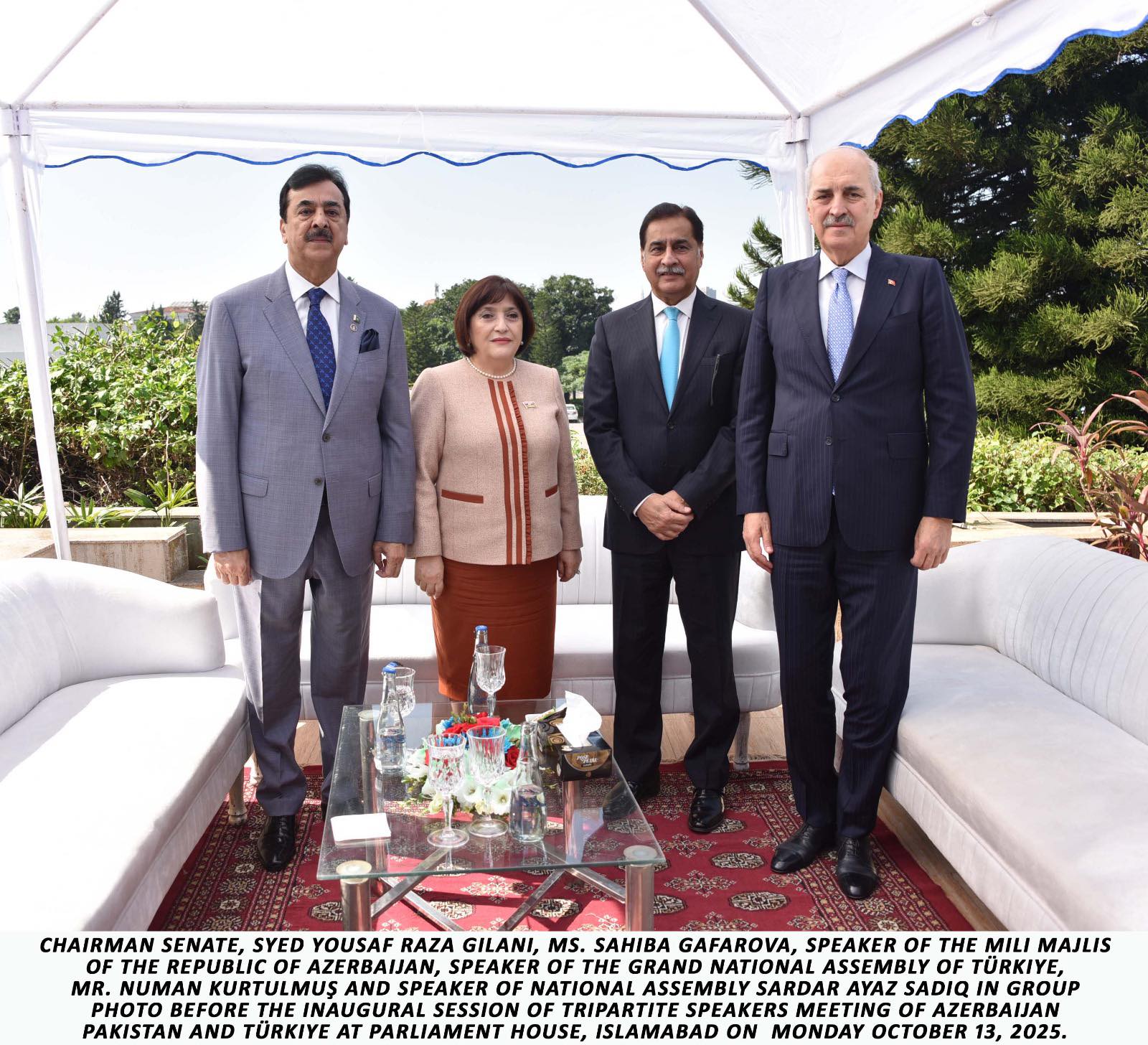
Concluding his remarks, the Chairman Senate expressed gratitude to the Speaker of the Grand National Assembly of Türkiye and the Speaker of the Milli Majlis of Azerbaijan for their participation. He expressed confidence that the Tripartite Speakers’ Meeting would pave the way for structured political collaboration, expand diplomatic coordination, and strengthen inter-parliamentary linkages for collective regional progress.
Trade between Pakistan and Türkiye rose to about US$1.4 billion in 2024, an increase of nearly 30% over the previous year.
However, business groups like FPCCI (Federation of Pakistan Chambers of Commerce & Industry) argue this figure is far below potential, calling for stronger institutional linkages and a Free Trade Agreement (FTA).
Pakistan–Azerbaijan Trade: Currently modest, bilateral trade is in the order of US$100 million between the two countries.
Data from PIDE (Pakistan Institute of Development Economics) shows mutual trade nearly tripled since 2017, reaching around US$40.88 million in 2022, with ambitions for large joint projects.
-
Türkiye’s Trade with Organization of Turkic States (including Azerbaijan): Over 2020–2024, Türkiye’s trade with Turkic states (Azerbaijan, Kazakhstan, Kyrgyzstan, Uzbekistan) reached about US$62.6 billion.
Of this, Azerbaijani-Turkish trade accounted for US$12.8 billion in exports from Türkiye to Azerbaijan, and about US$5.3 billion in imports from Azerbaijan.
In the Economic Cooperation Organization (ECO) region, intra-region trade rose to USD 96.5 billion in 2022, up from USD 76 billion in 2021. Still, this represents only around 9.1% of member countries’ total trade, suggesting large untapped potential.
The Istanbul-Tehran-Islamabad (ITI) Railway Corridor is frequently cited as a major route to strengthen regional trade. President Zardari and others have referred to it as a key potential conduit.
The International North–South Transport Corridor (INSTC) also figures in discussions of how to enhance trade linkages with Central Asia and beyond.
Air connectivity between Pakistan and Azerbaijan: Currently “five weekly flights from Lahore and two from Islamabad,” with plans to increase frequency.
The business community, through FPCCI, has urged swift negotiation of a Free Trade Agreement with Türkiye. They believe sectors like textiles, surgical goods, sports goods, rice, and leather have potential. They also call for improvements in logistics, banking channels, and customs to facilitate smoother trade.
Azerbaijan’s Ambassador in Islamabad emphasized that private sector can convert brotherly relations into substantive trade growth. ICCI also highlighted increasing air connectivity as a tool for boosting people-to-people contacts and commerce.
Their research points to Pakistan-Azerbaijan trade being under-exploited. Projects valued around US$2 billion are under discussion. Also highlighted is that despite geographic distance (≈2,200 km), historical linkages via the Silk
-
Road and overlap with CPEC provide foundations for stronger collaboration.
Held round tables on “Pakistan’s Relations with Central Asia and Azerbaijan: Imperatives of Regional Connectivity.” Experts from ISSI emphasized challenges: banking constraints, the need for information sharing, better infrastructure, and joint ventures to appeal to the Central Asian and Azerbaijan markets.
-
Voice of Experts
Atif Ikram Sheikh (President, FPCCI):
“The current trade volume [between Pakistan and Türkiye] does not truly reflect the historic brotherly ties and close diplomatic relations between the two nations.”
He also emphasised the importance of “strengthening institutional linkages and private sector cooperation to unlock the full potential of Pakistan-Turkey trade.”
________________________________________
Syed Mazhar Ali Nasir (Chairman, Pakistan-Turkey Business Council, FPCCI):
“There is an urgent need for the early signing of a Free Trade Agreement (FTA) between Pakistan and Türkiye. Despite the shared membership of platforms such as OIC, D-8, and ECO, bilateral trade remains below potential.”
________________________________________
Pakistan’s Prime Minister Shehbaz Sharif (on Pakistan-Azerbaijan relations):
“Pakistan and Azerbaijan have the potential to enhance their bilateral trade to two billion dollars.”
He noted that both countries should “move forward by focusing on the areas where the bilateral trade can be enhanced … establishment of a North South Corridor for a reliable and cost-effective transportation system and connectivity is another important step.”
________________________________________
Ambassador Khazar Farhadov (Azerbaijan to Pakistan):
“The private sector holds the key to transforming the deep-rooted brotherly relations between Pakistan and Azerbaijan into strong economic and commercial partnerships … increased air connectivity … is significantly enhancing business and people-to-people exchanges.”
________________________________________
Pakistan’s Ambassador to Azerbaijan Qasim Mohiuddin:
“The trade level between the two countries is below the potential. Under the vision of the leadership of our countries, serious efforts are being made to expand relations in various sectors. … We have recently implemented the Preferential Trade Agreement (PTA) and the Transit Trade Agreement (TTA). The two sides are also discussing cooperation in the energy sector and infrastructure development.”
________________________________________
“According to Ambassador Khazar Farhadov, ‘the private sector holds the key…’ This underscores that parliamentary diplomacy should lead to concrete measures—such as expanding air routes or trade facilitation systems—that help business communities on the ground. Meanwhile, FPCCI’s leadership, including Atif Ikram Sheikh and Syed Mazhar Ali Nasir, have stressed that trade with Türkiye is under-exploited, and called for an early Free Trade Agreement.”
-
Fostering Political Cooperation