

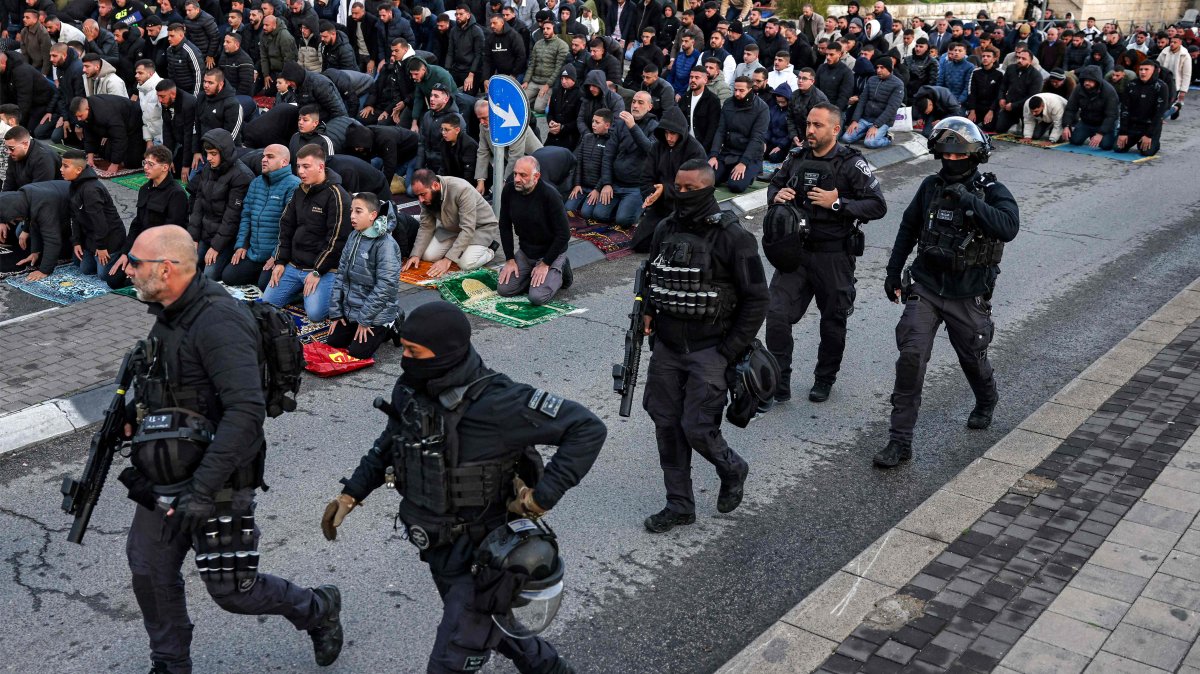
Hundreds of Muslim worshippers held Eid prayers at the gates of Jerusalem’s Old City on Friday after Israeli authorities sealed off access to the Al-Aqsa Mosque in occupied East Jerusalem and other sacred sites amid the ongoing U.S.-Israeli war with Iran.
Since Israel and the U.S. started the war with Iran on Feb. 28, Israeli authorities have closed access to Jerusalem’s world-renowned holy sites over security concerns, Al-Aqsa Mosque for Muslims, the Church of the Holy Sepulchre for Christians and the Western Wall for Jews.
Researchers say this is the first time the Al-Aqsa Mosque, Islam’s third-holiest site, has been closed during the last 10 days of Ramadan and for Eid al-Fitr since Israel’s occupation of East Jerusalem in 1967.
As Ramadan concluded and Eid al-Fitr began, hundreds of Palestinian worshippers gathered at dawn outside the Old City carrying prayer mats, determined to observe the holiday despite being barred from entering the Al-Aqsa compound.
Many described the situation as unprecedented and deeply painful, highlighting the emotional toll of being denied access to one of Islam’s holiest sites during the most sacred period of the Islamic calendar.
“This is a catastrophic situation for the people of Jerusalem, for Palestinians and for Muslims everywhere,” said Wajdi Mohammed Shweiki, reflecting the widespread frustration and grief among worshippers.
Al-Aqsa remained inaccessible throughout the final days of Ramadan and into Eid, preventing thousands from performing prayers traditionally attended by tens of thousands. Observers said this marked an unprecedented restriction in recent decades.
At the gates of the Old City, worshippers chanted “Allahu akbar” and recited the shahada as they tried to approach the mosque. Israeli police blocked their path, using force, including physical blows and tear gas, to disperse the crowd.
Despite the restrictions, a small group of worshippers managed to pray near Herod’s Gate, where an imam delivered a short sermon urging resilience and invoking justice. “Pray and remain steadfast. May God grant victory to the oppressed,” he told the gathered crowd.
The limited gathering contrasted sharply with the tens of thousands who normally converge on Al-Aqsa for Eid prayers. Palestinian officials and residents warned that continued restrictions threaten longstanding agreements governing access to the holy site and could further limit religious freedom in Jerusalem.
For many worshippers, missing Al-Aqsa during Ramadan and Eid has left a profound emotional impact. “Eid without Al-Aqsa feels like a broken heart,” one attendee said.
“Today, Al-Aqsa has been taken from us. It’s a sad and painful Ramadan,” Wajdi Mohammed Shweiki, a silver-haired Palestinian man in his 60s, told Agence France-Presse (AFP).
“It’s a catastrophic situation for the inhabitants of Jerusalem, for Palestinians in general and for all Muslims across the globe.”