
CPEC 2 Development Accelerates Economic Transformation in Pakistan
Pakistan–China Partnership Strengthens as CPEC Moves Toward Industrial Development

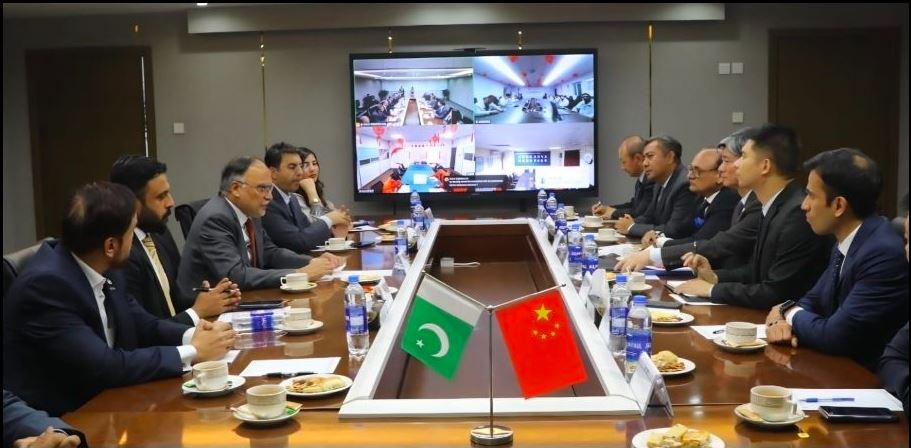
- CPEC 2: New projects, infrastructure upgrades, and industrial cooperation signal the next phase of development under the China-Pakistan Economic Corridor.
- Minister Appreciates Long-Term Commitment of Chinese Enterprise in Pakistan’s Development
By Muhammad Arif, Editor NSN.Asia
Islamabad: Federal Minister for Planning, Development and Special Initiatives, Ahsan Iqbal, visited the newly established Regional Headquarters of China Energy Engineering Corporation (CEEC) Pakistan, accompanied by senior officials from the Ministry of Planning.
The Minister was received by CEEC’s Managing Director Mr. Wang Hui Hua, Senior Advisor Dr. Hassan Daud butt, and other senior representatives of CEEC. The visit coincided with celebrations of the Chinese Spring Festival, the Lantern Festival.
During the briefing, the Managing Director highlighted CEEC’s leading role in advancing the China–Pakistan Economic Corridor (CPEC), including the development of the Suki Kinari Hydropower Project and continued work on the Azad Pattan Hydropower Project. He noted that CEEC has undertaken a significant share of CPEC power generation projects, contributing meaningfully to Pakistan’s energy security and sustainable economic growth.
Mr. Wang emphasized that CEEC’s Pakistan Headquarters a fully invested and constructed by the company reflects its confidence in Pakistan’s future and affirmed long-term commitment to local partnership and development.
Minister Ahsan Iqbal appreciated CEEC’s sustained investment and strategic contributions, stating that the company’s presence demonstrates the depth of Pakistan–China friendship as both countries mark 75 years of diplomatic relations and 13 years of CPEC cooperation. He commended Chinese support for Pakistan’s transition toward green and sustainable energy and reviewed the progress of ongoing hydropower projects under CEEC.
He informed that, Pakistan is actively developing dynamic, multi-pronged strategies, including new policy instruments and structural reforms, aimed at fostering sustainable economic growth and ensuring win-win cooperation with our Chinese partners. Government of Pakistan through its URAAN Pakistan program, has set clear targets for economic development where energy sector growth is a key pillar.
The visit concluded with the formal inauguration of CEEC Pakistan’s Regional office, reaffirming the shared resolve to strengthen bilateral cooperation and advance Pakistan’s long-term development goals.
Renewed Cooperation under China-Pakistan Economic Corridor
Pakistan and China are reinforcing their long-standing strategic partnership through renewed cooperation under the China-Pakistan Economic Corridor (CPEC), a flagship development initiative that continues to reshape Pakistan’s infrastructure, energy sector, and regional connectivity. Officials from both countries say the next phase of the project will focus on industrial growth, technological cooperation, and sustainable development, strengthening economic ties and creating new opportunities for regional integration.
- Strengthening Economic Cooperation
Pakistan and China have recently reaffirmed their commitment to advancing the next phase of CPEC, emphasizing industrialization, agricultural modernization, and special economic zones. Government officials say the focus is shifting from large infrastructure construction toward long-term economic collaboration that supports productivity, employment generation, and exports.
Pakistani policymakers view the evolving CPEC framework as a catalyst for economic transformation. New investments are expected to accelerate development in sectors such as logistics, manufacturing, energy, information technology, and agriculture.
Chinese companies have shown increasing interest in establishing manufacturing facilities in Pakistan’s special economic zones. These zones aim to attract foreign investment, encourage technology transfer, and integrate Pakistan more deeply into global supply chains.
Economic analysts note that such cooperation can help Pakistan diversify its economy while improving industrial capacity. With better transport networks and energy infrastructure already established through earlier CPEC projects, Pakistan is positioning itself as a regional trade and logistics hub.
- Infrastructure Achievements Under CPEC
Since its launch in 2015, CPEC has produced several major infrastructure projects across Pakistan. These include highways, power plants, and modernized transport corridors linking major cities and ports.
One of the most significant developments has been the expansion of Pakistan’s energy capacity. New power generation projects have helped address electricity shortages that previously constrained industrial growth and economic activity.
Road and transport infrastructure have also improved connectivity across provinces. Highways linking northern and southern regions have reduced travel time and facilitated trade within the country.
The development of Gwadar Port in Balochistan remains a central component of the corridor. Gwadar is envisioned as a key maritime hub connecting South Asia, Central Asia, and the Middle East. Infrastructure upgrades, port expansion, and urban development initiatives are gradually transforming the city into an emerging commercial center.
Improved logistics and connectivity are expected to strengthen Pakistan’s role in regional trade networks while opening new routes for international commerce.
- Industrial Cooperation and Special Economic Zones
As CPEC moves into its second phase, industrial cooperation has become a central priority. Pakistan has established several special economic zones designed to attract foreign investors and promote local manufacturing.
These zones offer incentives such as tax benefits, infrastructure support, and streamlined regulations. The goal is to create industrial clusters that support export-oriented growth and employment.
Chinese companies are expected to play a major role in developing these zones by establishing factories, technology partnerships, and joint ventures with Pakistani firms.
Economists suggest that such partnerships can enhance Pakistan’s industrial competitiveness while encouraging innovation and skill development among the local workforce.
In addition, collaboration in agriculture is gaining momentum. Joint research initiatives and agricultural modernization programs aim to improve crop productivity, introduce advanced farming technologies, and strengthen food security.
- Regional Connectivity and Strategic Importance
CPEC holds strategic significance not only for Pakistan and China but also for the wider region. By connecting western China to the Arabian Sea through Pakistan, the corridor provides a shorter and more efficient route for trade and energy transportation.
This connectivity is expected to facilitate economic integration among neighboring regions including Central Asia, South Asia, and the Middle East.
Improved infrastructure networks could also support cross-border trade and economic cooperation among regional economies. Analysts say the corridor has the potential to become a key link in broader regional development initiatives.
Pakistan’s geographic position at the crossroads of South Asia, Central Asia, and the Middle East places it in a unique position to benefit from expanding regional connectivity.
- Background: The Vision Behind CPEC
The China-Pakistan Economic Corridor was launched as a flagship component of China’s broader Belt and Road Initiative. The project was designed to promote infrastructure development, trade connectivity, and economic cooperation between participating countries.
Initial agreements signed in 2015 outlined a long-term framework for investments in energy, transport infrastructure, industrial zones, and port development.
Early CPEC projects focused primarily on addressing Pakistan’s critical infrastructure gaps. Energy shortages and transportation bottlenecks were identified as key obstacles to economic growth.
Through investments in power plants, highways, and logistics networks, the first phase of CPEC aimed to stabilize Pakistan’s energy supply and improve national connectivity.
The next phase emphasizes sustainable economic growth, industrialization, and innovation-driven cooperation.
Experts believe that the transition from infrastructure construction to economic development marks an important evolution in the corridor’s long-term strategy.
- Challenges and Opportunities
While CPEC has delivered significant infrastructure improvements, policymakers acknowledge that continued progress will require careful planning, transparency, and effective implementation.
Ensuring that economic zones attract sustained investment, strengthening local industrial capacity, and expanding workforce training programs will be critical to maximizing the corridor’s benefits.
At the same time, analysts see significant opportunities emerging from deeper cooperation in technology, digital connectivity, and green energy.
Renewable energy projects, smart infrastructure systems, and digital trade platforms could become important areas of collaboration in the coming years.
Such initiatives would align with global trends toward sustainable development and innovation-driven economic growth.
- Positive Outlook for China-Pakistan Partnership
Despite challenges, the long-term outlook for China-Pakistan cooperation remains optimistic. The two countries have maintained a close strategic partnership for decades, built on mutual trust, economic collaboration, and diplomatic support.
CPEC is widely regarded as a symbol of this partnership, reflecting a shared commitment to development and regional connectivity.
Officials from both countries have repeatedly emphasized that the corridor represents a long-term vision rather than a short-term project. Continued cooperation in trade, infrastructure, technology, and cultural exchange is expected to deepen bilateral ties.
For Pakistan, the corridor offers opportunities to modernize infrastructure, expand industrial production, and strengthen integration with regional and global markets.
For China, the partnership enhances economic connectivity while supporting broader regional development initiatives.
Conclusion
As CPEC enters its next phase, Pakistan and China are seeking to build on the progress achieved during the past decade. By focusing on industrial cooperation, innovation, and sustainable development, the two countries aim to unlock new economic opportunities while strengthening regional connectivity.
Observers say the continued evolution of CPEC reflects the enduring strength of the China-Pakistan partnership. With shared commitment and long-term planning, the corridor has the potential to remain a cornerstone of economic cooperation and a powerful driver of development for both nations in the years ahead.