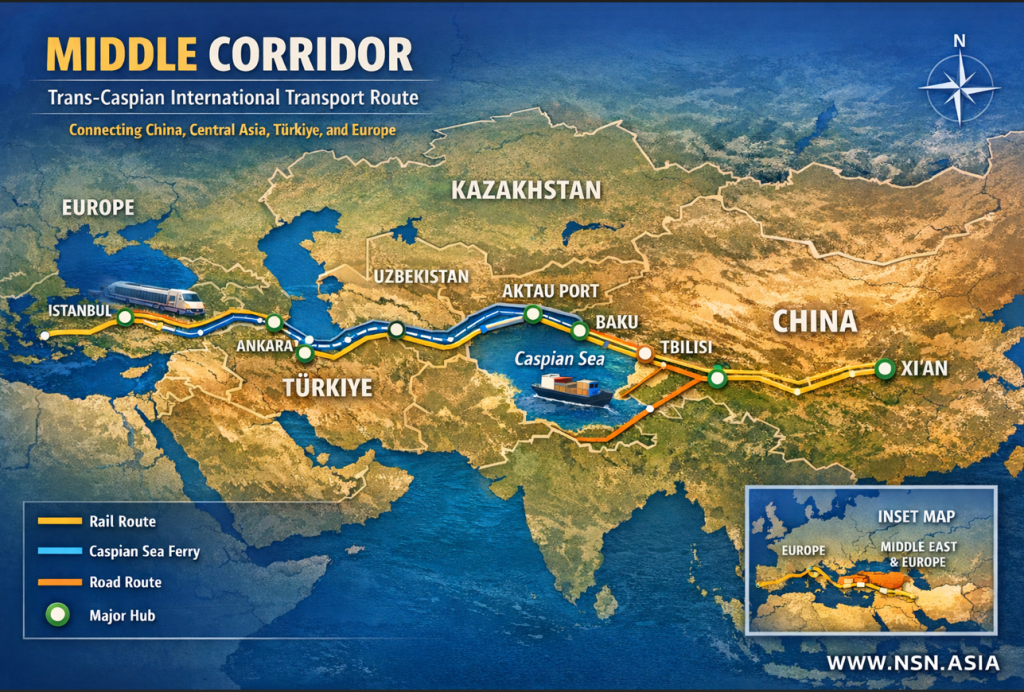


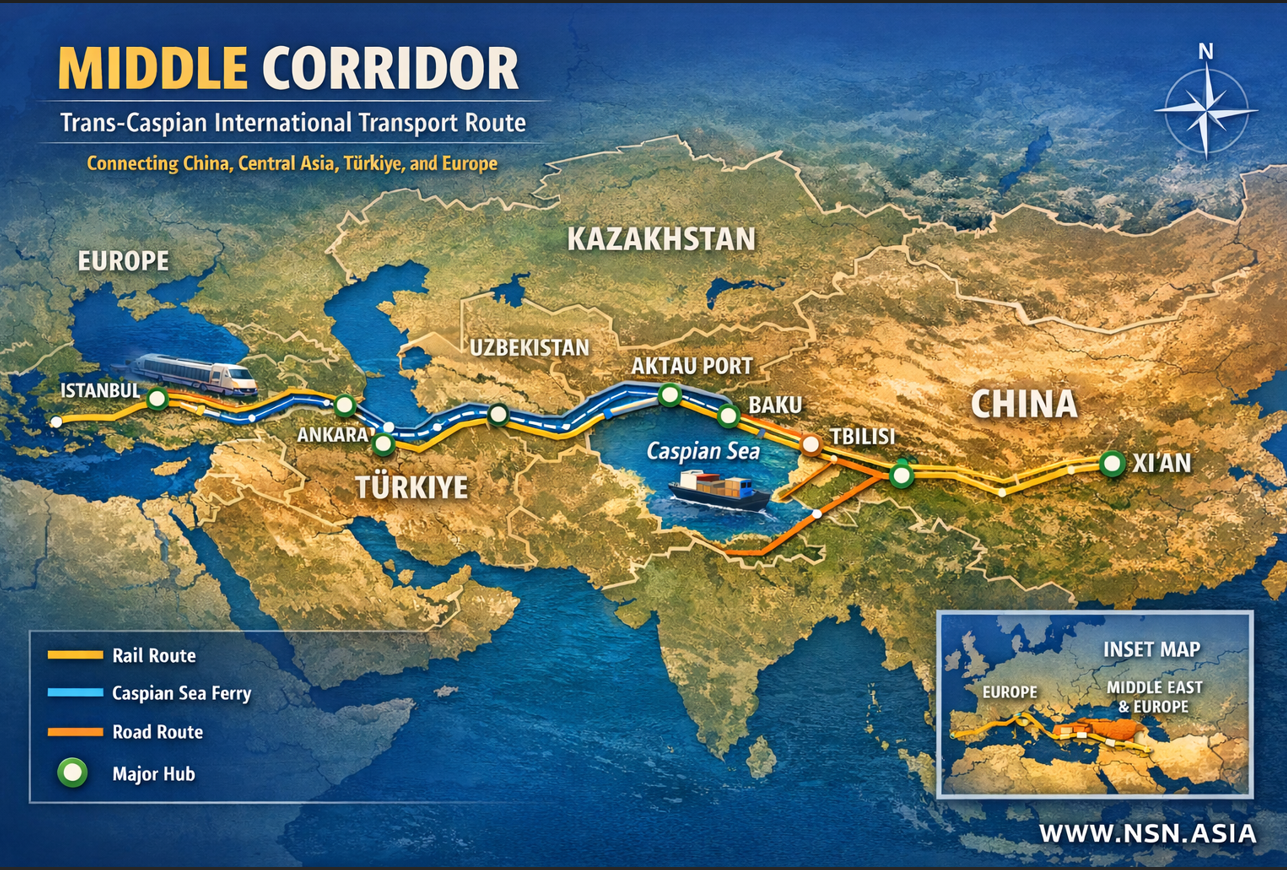
The Middle Corridor, officially known as the Trans-Caspian International Transport Route (TITR), is rapidly transforming into one of the most strategically significant trade routes in the world. Stretching from China through Central Asia and the Caucasus into Türkiye, and further into Europe and the Middle East, this corridor represents a modern revival of the ancient Silk Road.
As global trade dynamics shift due to geopolitical tensions and economic realignments, the Middle Corridor is emerging as a vital alternative to traditional northern and maritime routes.
Historical Evolution: From Silk Road to Strategic Corridor
The Middle Corridor traces its origins back to the ancient Silk Road, where caravans carried goods across Eurasia for centuries. In the modern era, the concept gained momentum in the early 2010s, aligned with China’s Belt and Road Initiative (BRI).
A major milestone in its development was the launch of the Baku–Tbilisi–Kars Railway in 2017, linking the South Caucasus directly with Türkiye’s rail network.
Route and Regional Connectivity
The Middle Corridor follows a multimodal route:
- China → Kazakhstan → Caspian Sea → Azerbaijan → Georgia → Türkiye → Europe
It connects key regions including:
- Central Asia
- South Caucasus
- Middle East
- European markets
The corridor relies heavily on maritime crossings via the Caspian Sea, making it a unique blend of rail and sea logistics.
Strategic Importance in a Changing Geopolitical Landscape
The corridor gained global relevance after the Russia-Ukraine Conflict, which disrupted traditional northern trade routes.
This shift has:
- Increased demand for alternative routes
- Boosted the importance of Türkiye as a transit hub
- Strengthened economic independence of Central Asian states
Today, the Middle Corridor is not just a transport route—it is a geopolitical instrument shaping Eurasian trade.
Infrastructure Development and Investments
Significant investments have been made to enhance the corridor’s efficiency:
- Expansion of rail networks in Kazakhstan
- Modernization of ports in Azerbaijan (Baku)
- Development of logistics hubs in Türkiye
- Upgrades to the Baku–Tbilisi–Kars railway
Türkiye, in particular, is positioning itself as a global logistics hub, connecting Asia with Europe and the Middle East.
Regional Cooperation and Integration
The success of the Middle Corridor depends on strong regional cooperation among:
- Kazakhstan, Uzbekistan, Turkmenistan
- Azerbaijan and Georgia
- Türkiye
- European Union partners
Organizations such as the Organization of Turkic States are playing an increasing role in coordination and policy alignment.
The corridor also aligns with European connectivity strategies aimed at reducing dependency on single trade routes.
Economic and Connectivity Impact
The Middle Corridor enhances:
Trade Efficiency
- Reduced transit time between Asia and Europe
- Diversified supply chains
Regional Integration
- Stronger economic ties across Eurasia
- Increased trade opportunities for landlocked countries
Energy and Digital Connectivity
- Supports pipelines and energy transport
- Facilitates digital infrastructure expansion under the Digital Silk Road
Progress and Current Status
The corridor has witnessed significant growth:
- Freight volumes have increased sharply since 2022
- Trade flows have diversified
- New rail services linking China and Europe via this route have been launched
However, challenges remain:
- Infrastructure bottlenecks
- Limited Caspian shipping capacity
- Complex customs procedures
Analytical Perspective (SWOT Analysis)
Strengths
- Strategic geographic positioning
- Strong political backing
- Multimodal flexibility
Weaknesses
- Operational inefficiencies
- Higher costs compared to established routes
Opportunities
- Rising global demand for alternative routes
- Increased EU and Asian investments
- Expansion into Middle Eastern markets
Threats
- Regional instability
- Competition from other global corridors
- Institutional fragmentation
Future Prospects
The future of the Middle Corridor appears highly promising:
- Expected to handle over 10 million tons of cargo annually by 2030
- Increased integration with Middle Eastern and South Asian routes
- Growth in green and digital transport systems
Türkiye is likely to emerge as a central logistics powerhouse, while Central Asia will gain greater economic independence and global relevance.
Conclusion
The Middle Corridor is redefining the landscape of global trade by offering a fast, flexible, and geopolitically viable route between Asia, Europe, and the Middle East.
With continued investment, institutional reforms, and regional cooperation, it has the potential to become a cornerstone of 21st-century Eurasian connectivity, reviving the Silk Road in a modern, strategic form.