Chinese Consulate Delegation Calls on Faryal Talpur, Reaffirms Pakistan-China Friendship
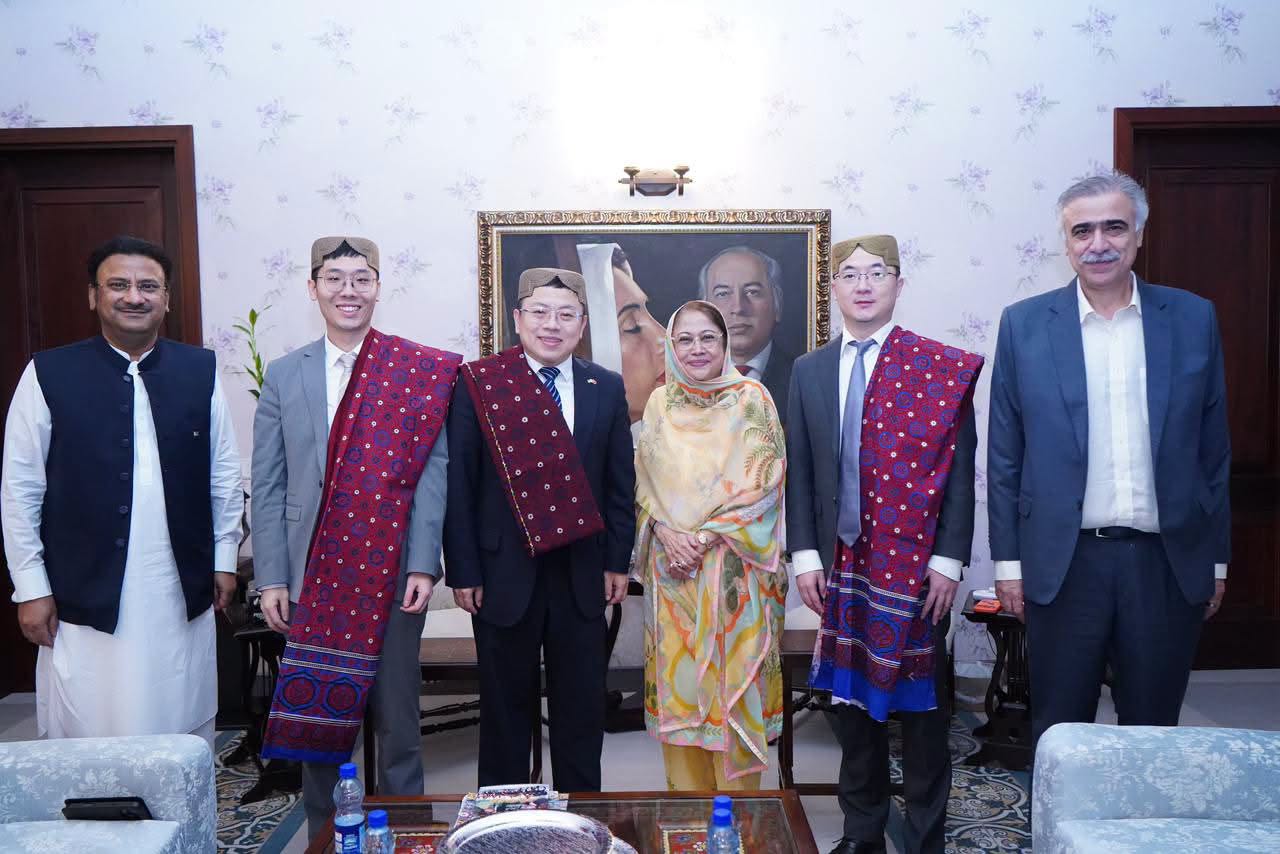
A Chinese Consulate delegation led by Acting Consul General Zhang Song met PPP Women Wing President Faryal Talpur at Zardari House, Karachi, to strengthen Pakistan-China ties.

-
Chinese Consulate Delegation Calls on Faryal Talpur, Reaffirms Pakistan-China Friendship
-
Meeting aimed at deepening the longstanding relationship between Pakistan and China.
-
Bhutto’s Legacy: Laying the Foundation for Pakistan-China Ties
By: Muhammad Arif, Editor NSN.Asia
Karachi, September 4, 2026: A delegation from the Consulate General of the People’s Republic of China in Karachi called on Mrs. Faryal Talpur, President of the Pakistan Peoples Party (PPP) Women Wing, at Zardari House, Karachi, in a meeting aimed at deepening the longstanding relationship between Pakistan and China.
Delegation and Attendees
The Chinese delegation was headed by Mr. Zhang Song, Acting Consul General of China in Karachi, who was accompanied by the Director of the Political Department and Mr. Wang Zhaoxiang, Protocol Secretary. Their visit to Zardari House, the political residence associated with the Bhutto-Zardari family and a key hub of PPP political activity in Karachi, underscored the significance both sides attached to the engagement.
The meeting was not limited to the Chinese delegation and Mrs. Talpur alone. It was also attended by senior figures from the Sindh government and provincial assembly, reflecting the broader institutional dimension of the interaction. Mr. Zia Ul Hassan Lanjar, the Sindh Minister for Home and Law, was present, as was Mr. Sohail Anwar Khan Siyal, a Member of the Provincial Assembly of Sindh who previously served as the province’s Home Minister. Their attendance signaled that the discussion extended beyond party-to-consulate diplomacy into matters touching the provincial government of Sindh as well.
A Cordial and Friendly Atmosphere
According to those present, the meeting was conducted in what was described as a cordial and friendly atmosphere. The core focus of the discussion was on reinforcing what both sides characterized as the longstanding and time-tested friendship between Pakistan and the People’s Republic of China — a relationship that has often been described by officials on both sides as an “all-weather” strategic partnership spanning decades of political, economic and security cooperation.
Beyond the bilateral relationship at the national level, the conversation also centered on strengthening the specific channels of engagement between the Consulate General of China in Karachi, the Government of Sindh, and the Pakistan Peoples Party. This three-way framework — linking a foreign diplomatic mission, a provincial government, and a major national political party — highlights the multi-layered nature of Pakistan-China cooperation, which extends well beyond formal state-to-state diplomacy into provincial and political-party level engagement.
Bhutto’s Legacy: Laying the Foundation for Pakistan-China Ties
The friendship invoked at Zardari House did not emerge in isolation. The PPP has long traced its association with Pakistan-China relations back to the party’s founder, Zulfiqar Ali Bhutto, who is widely credited with laying much of the groundwork for the modern Pakistan-China partnership.
As Pakistan’s Foreign Minister in the early 1960s, Bhutto was instrumental in negotiating the Sino-Pakistan Boundary Agreement of 1963, which resolved territorial questions between the two countries and marked an early milestone in formalizing their relationship. The agreement helped set the tone for a partnership built on mutual trust at a time when Pakistan was recalibrating its foreign policy amid shifting Cold War alignments in South Asia.
Bhutto’s role deepened further after he became President and later Prime Minister of Pakistan in the 1970s. During this period, Pakistan played a quietly pivotal role in facilitating the historic opening between China and the United States, most notably by providing the channel through which secret diplomatic contacts were arranged in 1971 — a development that helped reshape global geopolitics and elevated Pakistan’s standing as a trusted interlocutor for Beijing. Under Bhutto’s leadership, Islamabad and Beijing also expanded cooperation across economic, infrastructure and defense lines, reinforcing what would come to be described by officials on both sides as an “all-weather” friendship.
This historical foundation is frequently invoked by PPP leaders, including members of the Bhutto-Zardari family, as part of the party’s political identity and its continued emphasis on close ties with Beijing. References to this legacy often surface during meetings between PPP leadership and Chinese officials, framing present-day engagement — such as the meeting at Zardari House — as a continuation of a relationship the party regards as one of its founding foreign policy achievements.
Talpur Highlights Enduring Bonds
Mrs. Faryal Talpur used the occasion to express her appreciation for what she described as the enduring bonds of friendship and cooperation between Pakistan and China. She underscored the importance of maintaining and further strengthening the close relationship between the two countries, framing it as a priority not only for the national government but for provincial and party-level stakeholders as well.
Her remarks are consistent with the PPP’s broader posture toward China, a relationship the party has historically emphasized during its periods in government in both Sindh and at the federal level. Sindh, as Pakistan’s second-most populous province and home to Karachi — the country’s largest city and commercial hub — has been a significant stakeholder in various China-linked initiatives over the years, making sustained engagement between Chinese diplomatic missions and the provincial leadership a recurring feature of the bilateral relationship.
Commitment to Continued Cooperation
All participants at the meeting reaffirmed their commitment to promoting friendship, mutual understanding, and cooperation between Pakistan and China. Particular emphasis was placed on the importance of continued engagement between the three key stakeholders present in spirit at the meeting: the Chinese Consulate in Karachi, the Government of Sindh, and the Pakistan Peoples Party.
This reaffirmation reflects a broader pattern seen in Pakistan-China relations, where diplomatic engagement is frequently pursued not just through federal channels in Islamabad but also through direct outreach to provincial governments and political parties, particularly in provinces like Sindh where Chinese-funded and Chinese-linked projects have had a notable footprint.
Meeting Concludes with Goodwill
The meeting concluded on a note of goodwill, with all sides expressing a shared resolve to further strengthen the close and friendly ties between Pakistan and China. No specific agreements, projects, or timelines were announced following the meeting, with the engagement instead serving primarily as a platform to reaffirm existing ties and personal and institutional goodwill between the two sides.
The visit adds to a steady rhythm of diplomatic engagement between Chinese consular officials and Pakistani political and provincial leadership in Karachi, a city that hosts one of China’s key diplomatic missions in Pakistan and remains central to the countries’ economic and infrastructure cooperation.
This article is based on the details provided in the original statement. Additional context on broader Pakistan-China relations has been included for background. For further updates or independent verification of statements made during the meeting, readers are encouraged to consult official statements from the PPP, the Government of Sindh, or the Chinese Consulate General in Karachi.